
Urban Nation, Berlin's Street Art Museum: A Visitor Guide
13 September 2026
Berlin is one of the world's graffiti capitals, and it holds one of the best-stocked museums devoted to urban art: URBAN NATION, at 7 Bülowstraße in Schöneberg. Admission is free, the façade is repainted for every exhibition, and the surrounding streets hold dozens of artworks. We visited in May 2026. Here is what you see inside, and why you should save time to wander the neighbourhood.

A street art museum funded by a social housing landlord
The story starts in 2013, and not in a gallery. The project was launched by the Stiftung Berliner Leben, the foundation of Gewobag, one of Berlin's largest housing associations, under the artistic direction of Yasha Young. The original idea was simple: invite international artists to paint walls across the city. The museum came later.
It opened in September 2017 in an 1880s Gründerzeit building renovated by the Berlin practice GRAFT: 3,500 m² of exhibition space, diagonal bridges crossing the volume, and intermediate floors removed so that pieces several metres tall can be hung. The opening show gathered more than 150 artists from more than 28 countries, among them Shepard Fairey, Herakut and photographer Martha Cooper.
The museum has no permanent collection: it runs long exhibitions instead, most of them built around works made on site. Entry stays free, with a voluntary donation.
The façade is the museum's first artwork
You recognise the building before you read the sign. For every exhibition the corner façade is entirely re-dressed: Ben Eine painted “Revolution” there in letters several metres high, DALeast flew a golden eagle across it, Icy & Sot staged the fall of the Wall on it, and in September 2024 Lady Pink, a pioneer of painting New York subway cars, turned it into a fantastical cityscape, half Berlin, half New York.
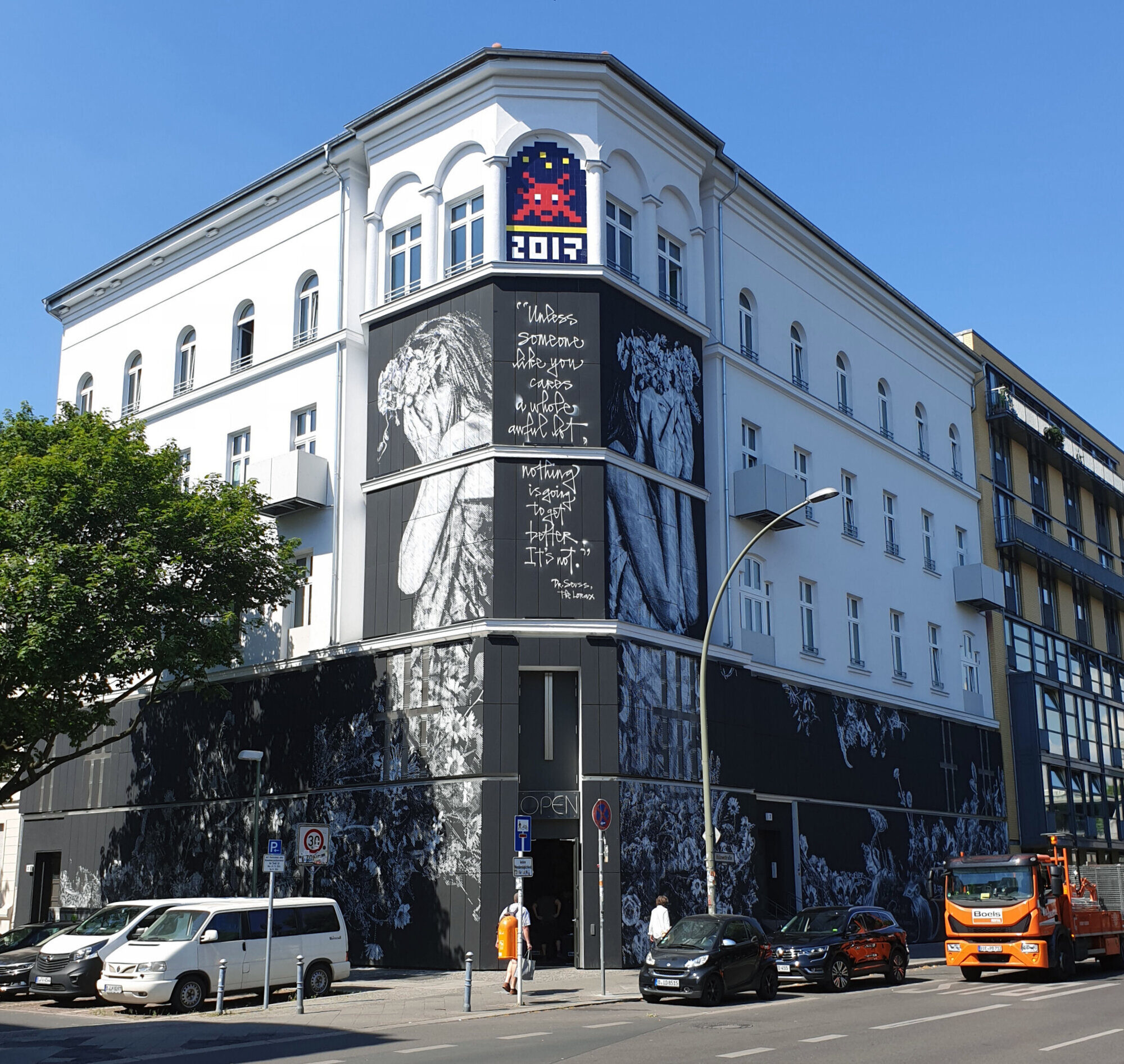
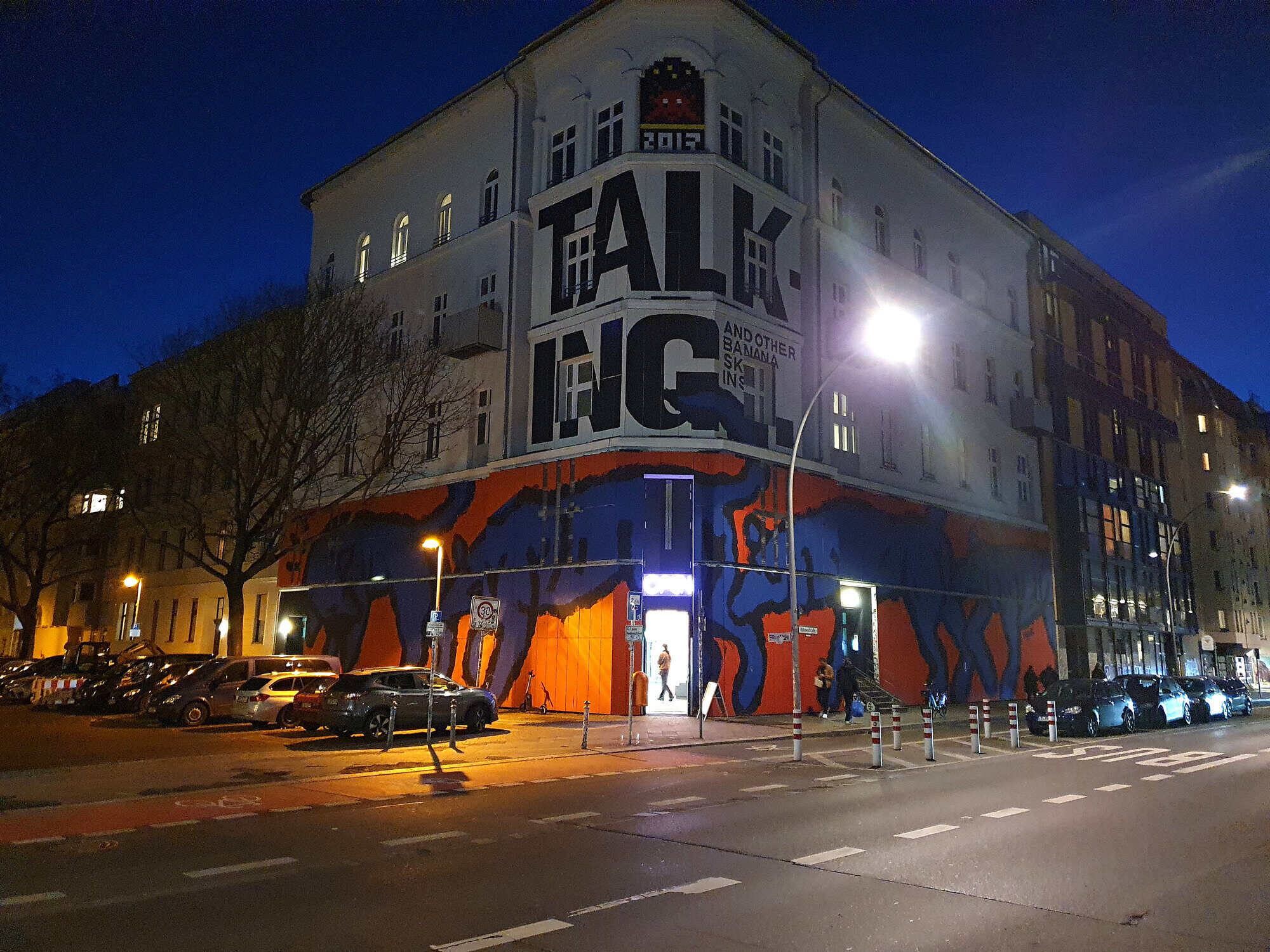
One detail never moves between shows: the Invader mosaic under the cornice, a red Space Invader on a blue ground, sitting above the date “2017”, the year the museum opened.
The painted walls around the building continue the story told by the façade: an elevated U-Bahn viaduct loaded with tagged carriages, fairy-tale houses, the Brooklyn Bridge, the Manhattan skyline and an orange cat the size of a doorway.


Earlier exhibitions left façades of their own, which only photography keeps today.
“Love Letters to the City”, the current exhibition
The show has filled the museum since 14 September 2024 and runs until 30 May 2027, so there is plenty of time left. Curator Michelle Houston split it into nine chapters, from “City as Muse” to “Let's Talk About Gentrification”, taking in “Space Hacking” and “De-Construct to Construct” along the way. More than fifty artists appear, from Banksy to Bordalo II, and fragments of the Wall on loan from the Stiftung Berliner Mauer are there to remind you what painting a wall means in this city.
Painting in public spaces is inherently political.
Michelle Houston, curator of the exhibition
Four pieces stayed with us.
Post-Graffiti: the DHL truck by Moses & Taps
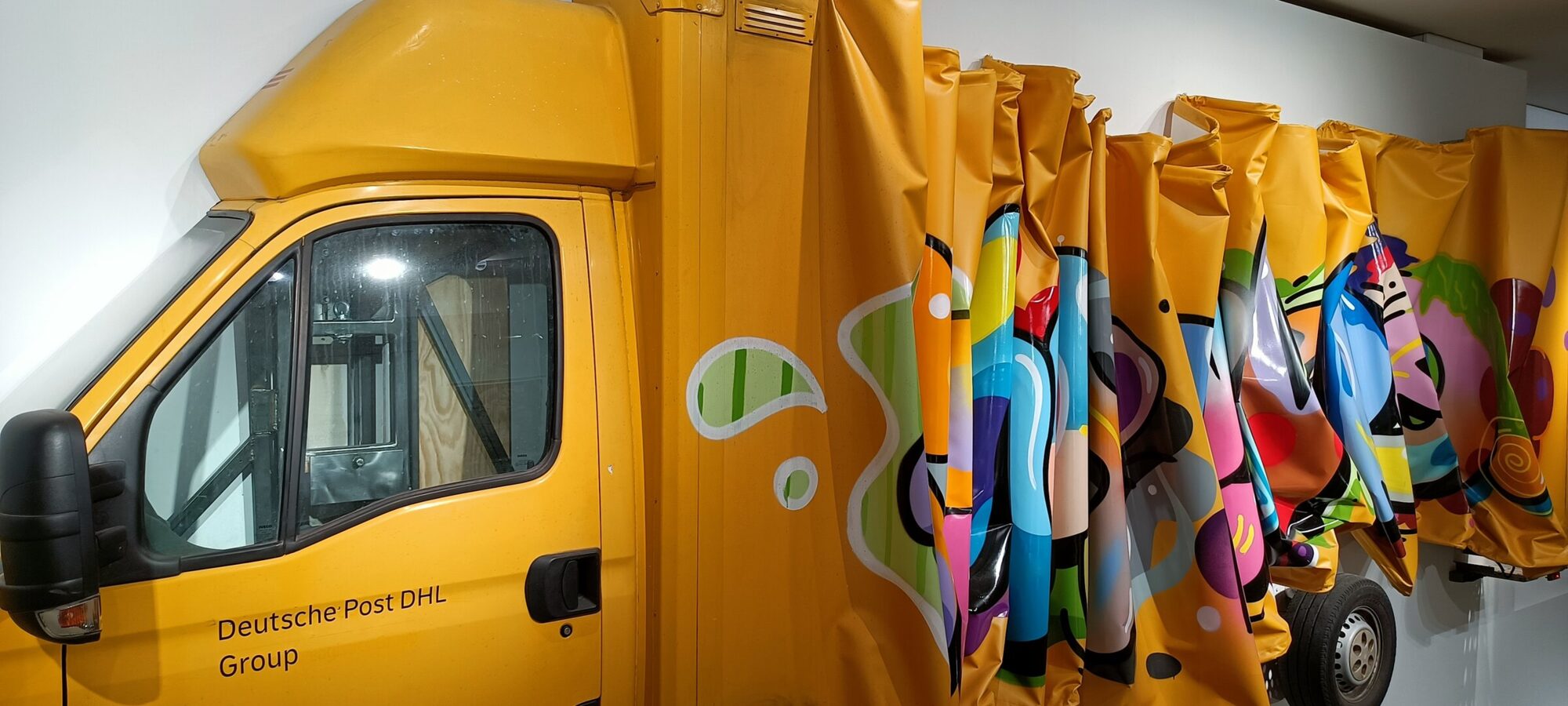
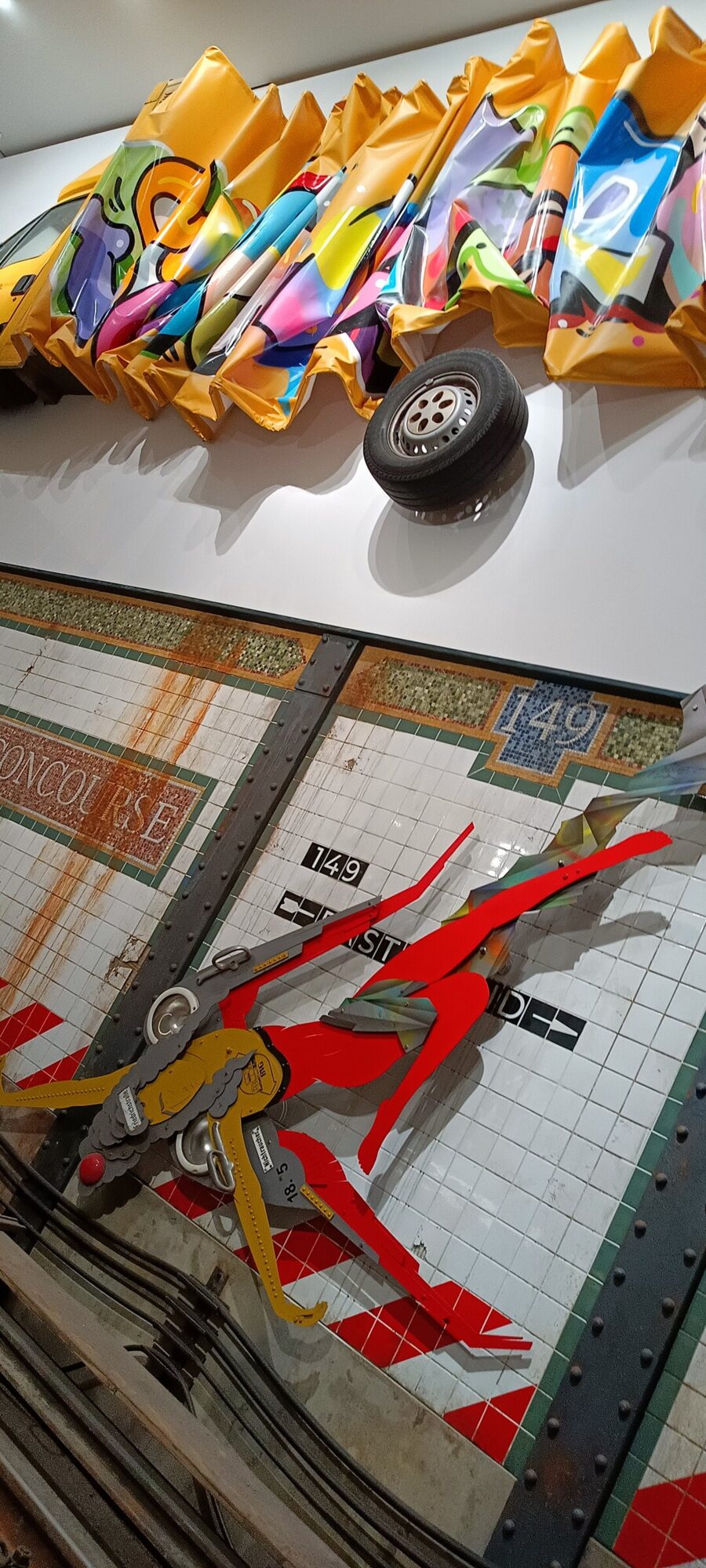
Germans Moses & Taps are trainwriters: they paint trains, and their whole vocabulary comes from there. For this exhibition they dismantled a parcel delivery truck and unfolded its PVC tarpaulin like a stretched canvas: eight metres long, Deutsche Post yellow, their cyan lettering pulled along the folds. The work is called Post-Graffiti (2024), a pun on art history's “post-” theories as much as on Deutsche Post. The museum label says it best: delivery trucks are part of the urban landscape, and in an age of online orders the next artwork might just park outside your door.
The writers' bench by Rocco und seine Brüder
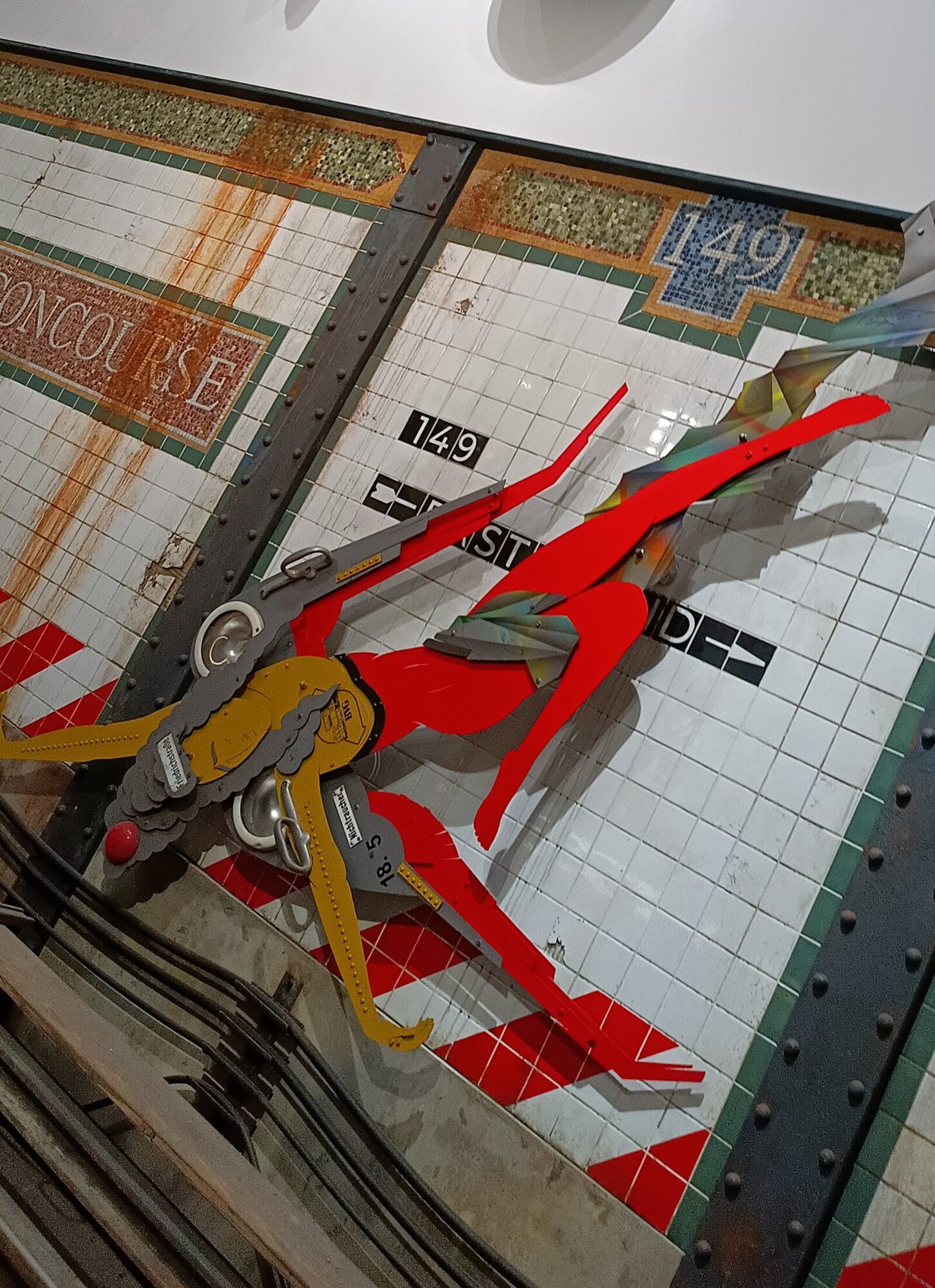
Below the truck, Berlin collective Rocco und seine Brüder rebuilt a hybrid writers' bench. The white tiling and the “149” and “CONCOURSE” mosaics come from 149th Street-Grand Concourse station in the Bronx, where New York writers of the 1970s sat to watch the trains they had just painted roll past. The “Nichtraucher” signs, the rails and the red and white band come from the Berlin U-Bahn instead. Two mythologies meet in one installation, cut from aluminium and reassembled in three dimensions.
Blek le Rat, the man who invented stencil art
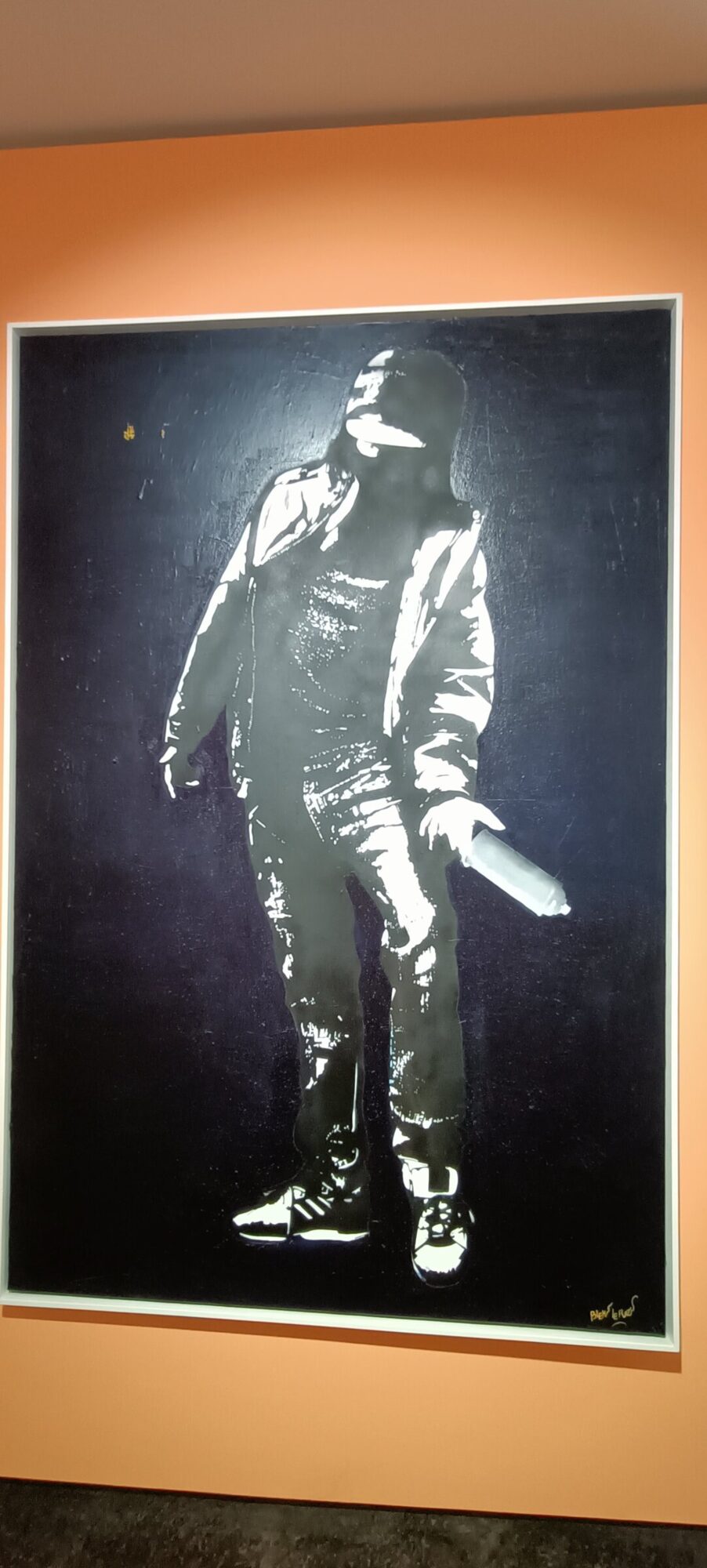
Parisian Blek le Rat cut his first stencils on the streets of Paris in 1981. Banksy has publicly acknowledged his debt to him: “every time I think I've painted something slightly original, I find out that Blek le Rat has done it as well, only twenty years earlier”. The canvas hung here shows a writer's silhouette, spray can in hand, white on black, signed in the bottom right with the small rat that gave him his name and that he painted by the thousand across Paris.
Vhils, a portrait carved into the wall
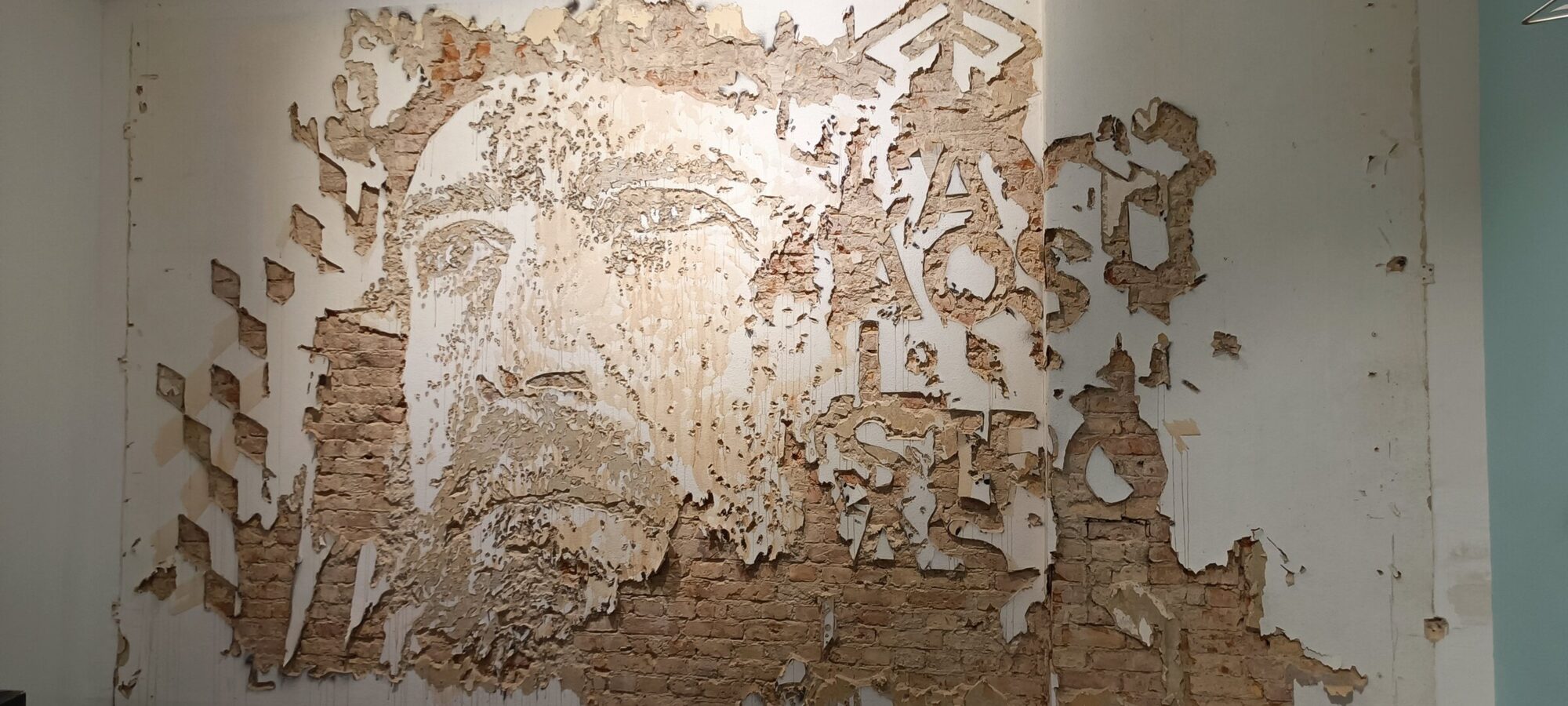
Portuguese artist Vhils (Alexandre Farto) does not add, he removes. Hammer, chisel, sometimes explosives: he digs through layers of paint, plaster and brick until a face emerges from the depth of the wall. The piece shown here was carved on site, in the “De-Construct to Construct” chapter he shares with Moses & Taps. Up close, the skin of the portrait is nothing but bare brick.
The Martha Cooper Library, graffiti's memory
The museum houses a research library named after Martha Cooper, the American photographer whose images of New York subway cars, published in 1984 in Subway Art with Henry Chalfant, travelled the world and served as a manual for generations of writers.
Opened in November 2021, it occupies the second floor and gathers monographs, academic work, handmade fanzines and graffiti magazines from the 1980s and 1990s. Some volumes exist in no other library in Berlin, and several carry a dedication to Martha Cooper herself. The reading room is free and open to anyone over 18 who registers with an ID, on Tuesdays from 10 am to 3.30 pm and Thursdays from 12 noon to 3.30 pm. It also runs its own series of events, “Martha Cooper Library Presents…”.
The real museum is outside: the walls of Bülowstraße
This is the part you miss if you leave too quickly. The mural programme launched in 2013 spread across the whole neighbourhood, and the blocks around the museum have become an open-air gallery, under the elevated U-Bahn viaduct that runs above the street. We have catalogued more than 60 artworks in Bülowstraße and neighbouring Zietenstraße alone, and 438 across Berlin.
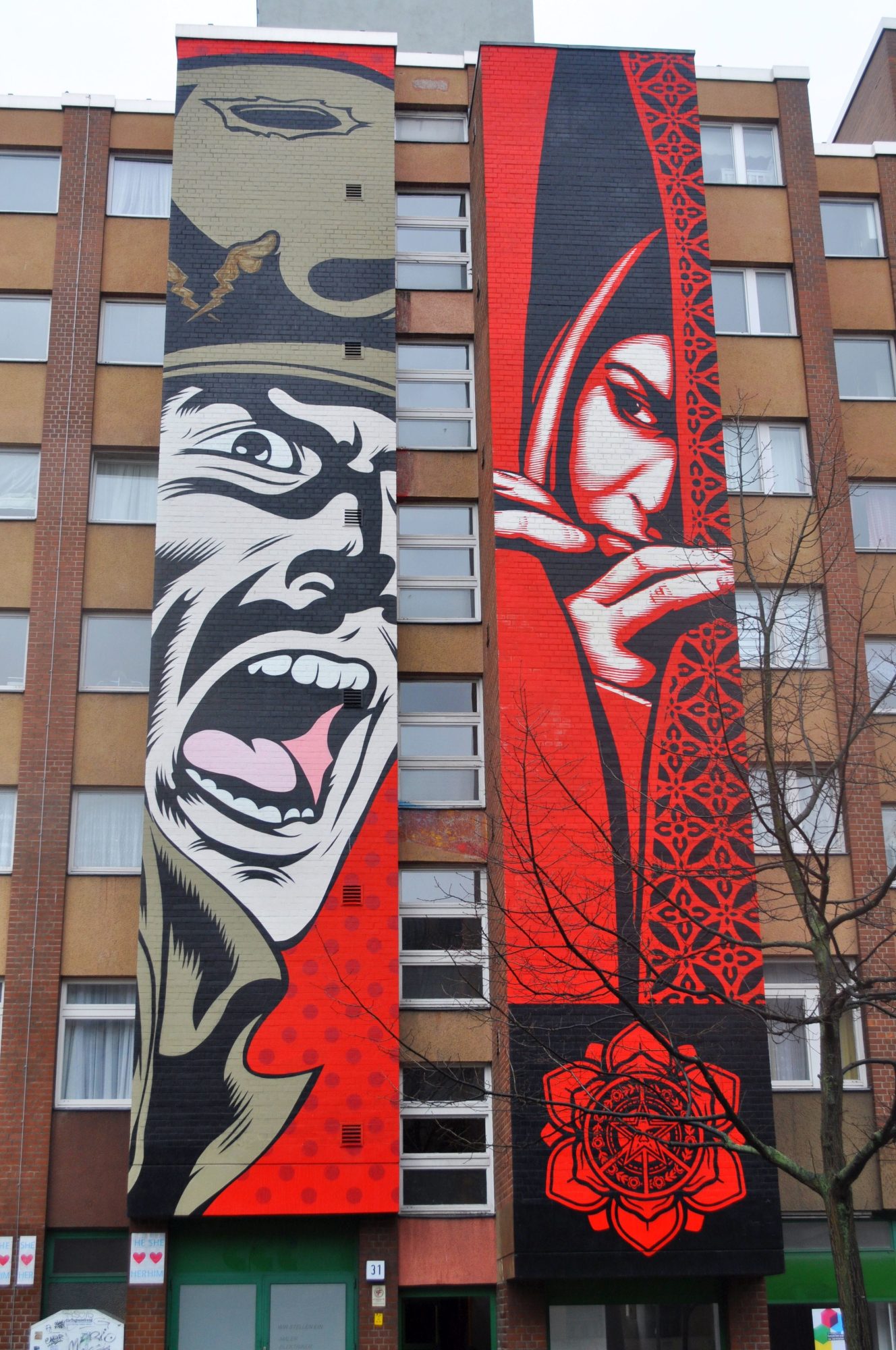 D*Face's scream and Obey's veiled woman, 31 Bülowstraße.
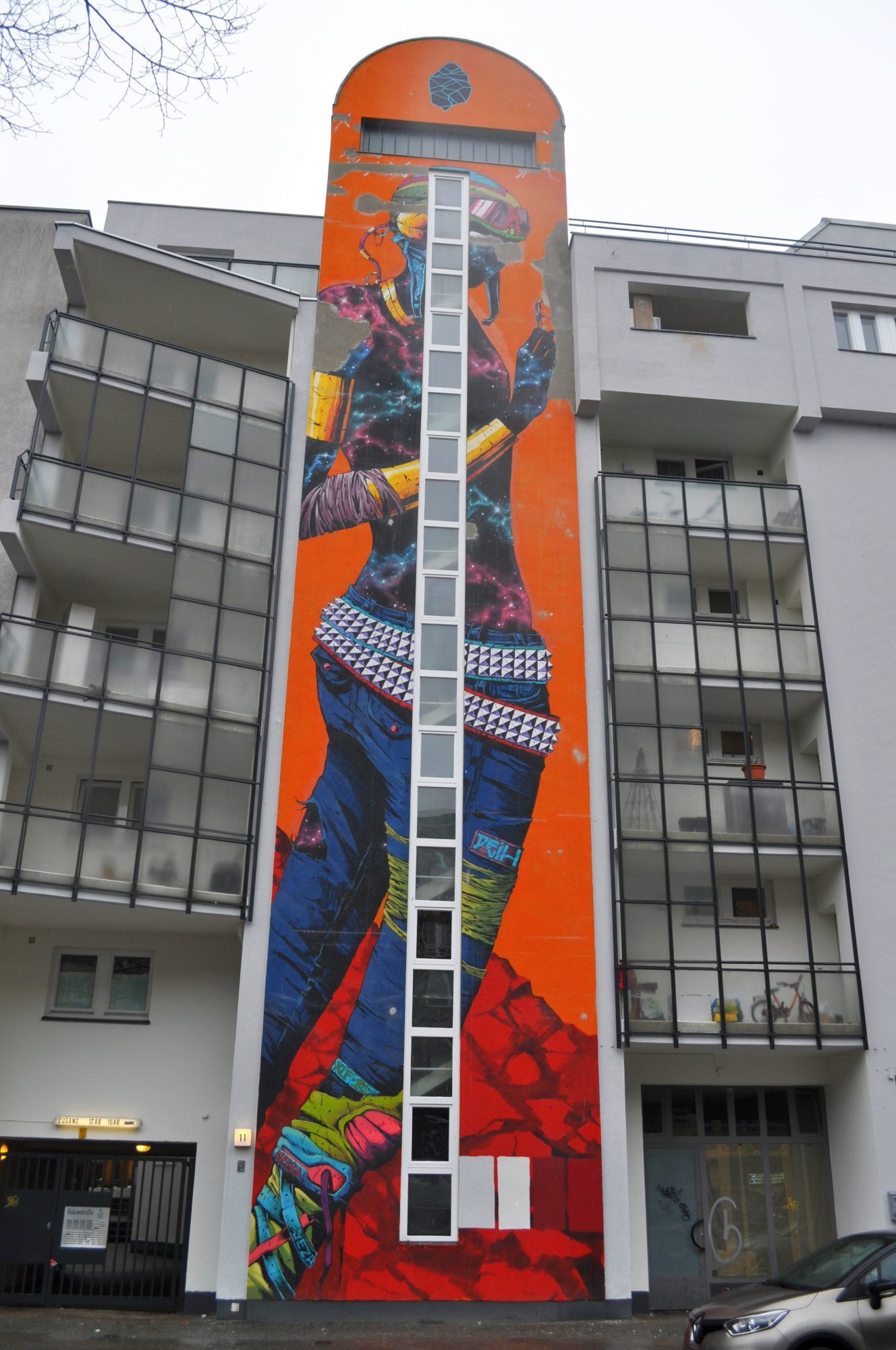 Cosmic figure by Deih xlf, Bülowstraße 11.
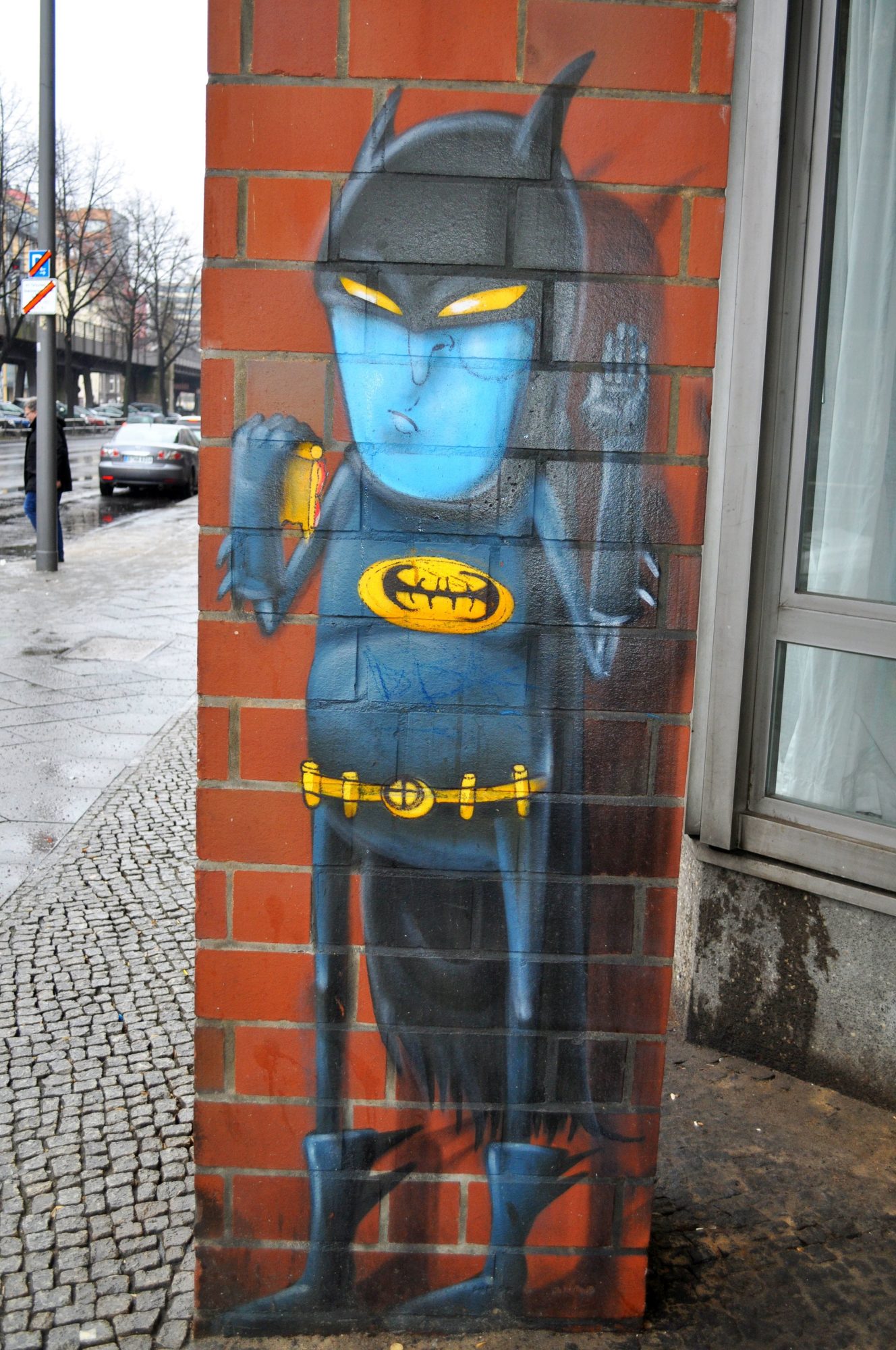 One of Cranio's nine blue characters, Bülowstraße 95.
 Vegan Flava's plant skull, 96 Bülowstraße.
 Don't Kill Me, a stencil by Nafir, 98 Bülowstraße.
 Gray Habitat by David de la Mano, Bülowstraße.
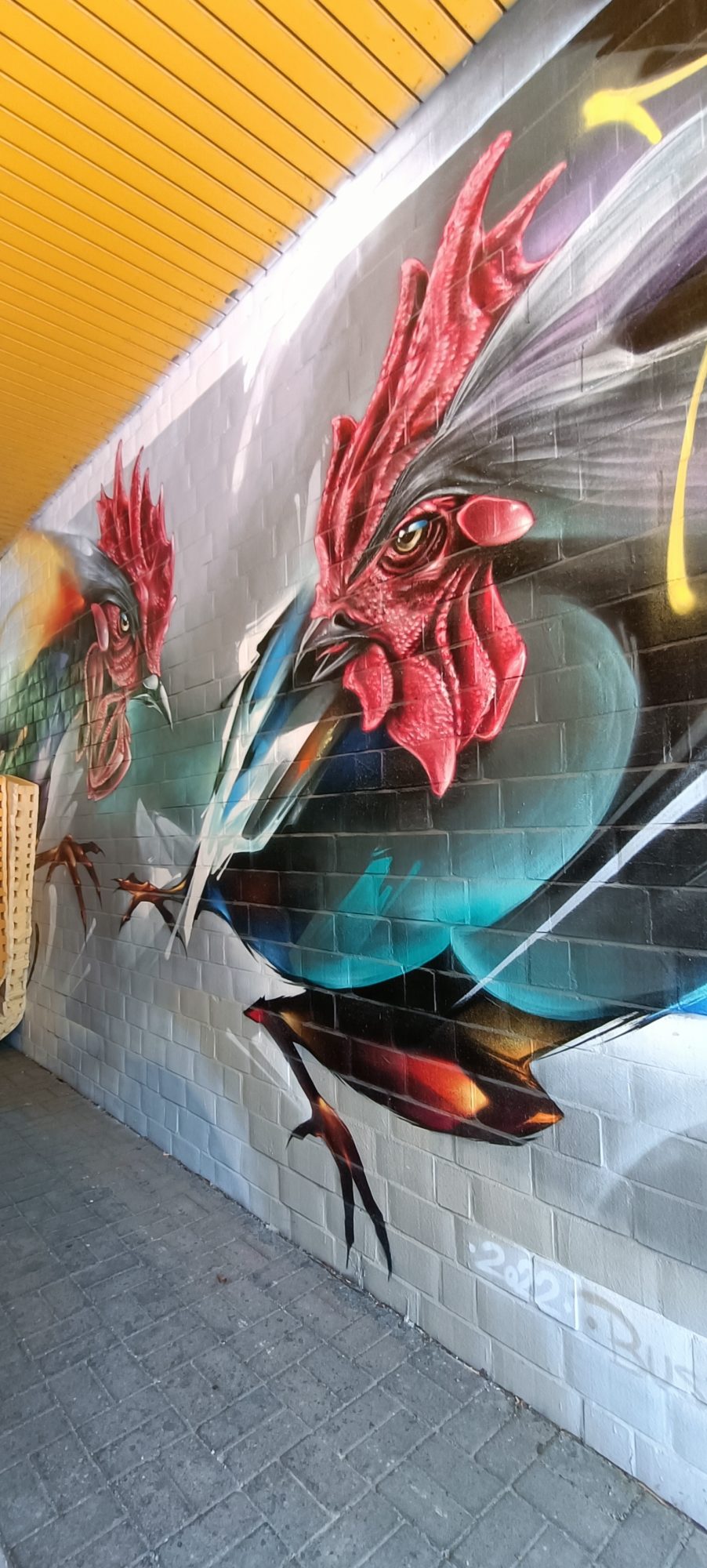 Cage Fight by Timo Waldner, 95 Bülowstraße.
 An Urban Nation shutter, 98 Bülowstraße.
A few landmarks, all less than ten minutes' walk from the museum:
- D*Face's scream and Obey's veiled woman, at 31 Bülowstraße: two heavyweights on the same gable.
- The blue characters by Cranio, at numbers 94 and 95: the Brazilian painted nine pieces in the same street.
- The cosmic figure by Deih xlf, at number 11, by the same Valencian artist you meet in the El Carmen district of Valencia.
- Gray Habitat by David de la Mano, with his swarming black silhouettes.
- Don't Kill Me by Nafir, an Iranian stencil at pavement height.
- The plant skull by Vegan Flava at number 96, and Cage Fight by Timo Waldner at 95.
- The Invader mosaic on the museum corner, worth 100 points in FlashInvaders.
The full neighbourhood map is on our Berlin map, so you can walk them all without missing one.
Practical information
- Address: Bülowstraße 7, 10783 Berlin-Schöneberg.
- Admission: free, voluntary donation.
- Opening hours: closed Monday; Tuesday and Wednesday 10 am to 6 pm; Thursday to Sunday 12 noon to 8 pm.
- Getting there: U-Bahn Nollendorfplatz (U1, U2, U3, U4), two minutes on foot, or Bülowstraße (U2), the elevated station on the street itself; buses 106, 187 and M19.
- Accessibility: the building is step-free.
- Current exhibition: “Love Letters to the City”, until 30 May 2027.
- Allow: one hour inside the museum, one more in the street.
Museum photos taken in May 2026. The street pieces are geolocated on street-artwork.com: if you photograph one that is missing, add it, contributing is open to everyone.
Back to blog