
Street Art in Le Panier (Marseille): 2026 Guide
20 September 2026
Le Panier is the oldest district in Marseille and one of the densest for urban art in the city. In its steep alleys in the 2nd arrondissement, murals do not spread across twenty-metre gable walls the way they do at Cours Julien. They take over doors, shutters, street corners and stair risers instead. We have geolocated 112 artworks within 800 metres of the Montée des Accoules, and this guide covers seven of them in detail. Expect a compact walk rather than a long one: the whole route fits inside a few hundred metres of cobbled lanes, and most of the walking is vertical.
The history of street art in Le Panier
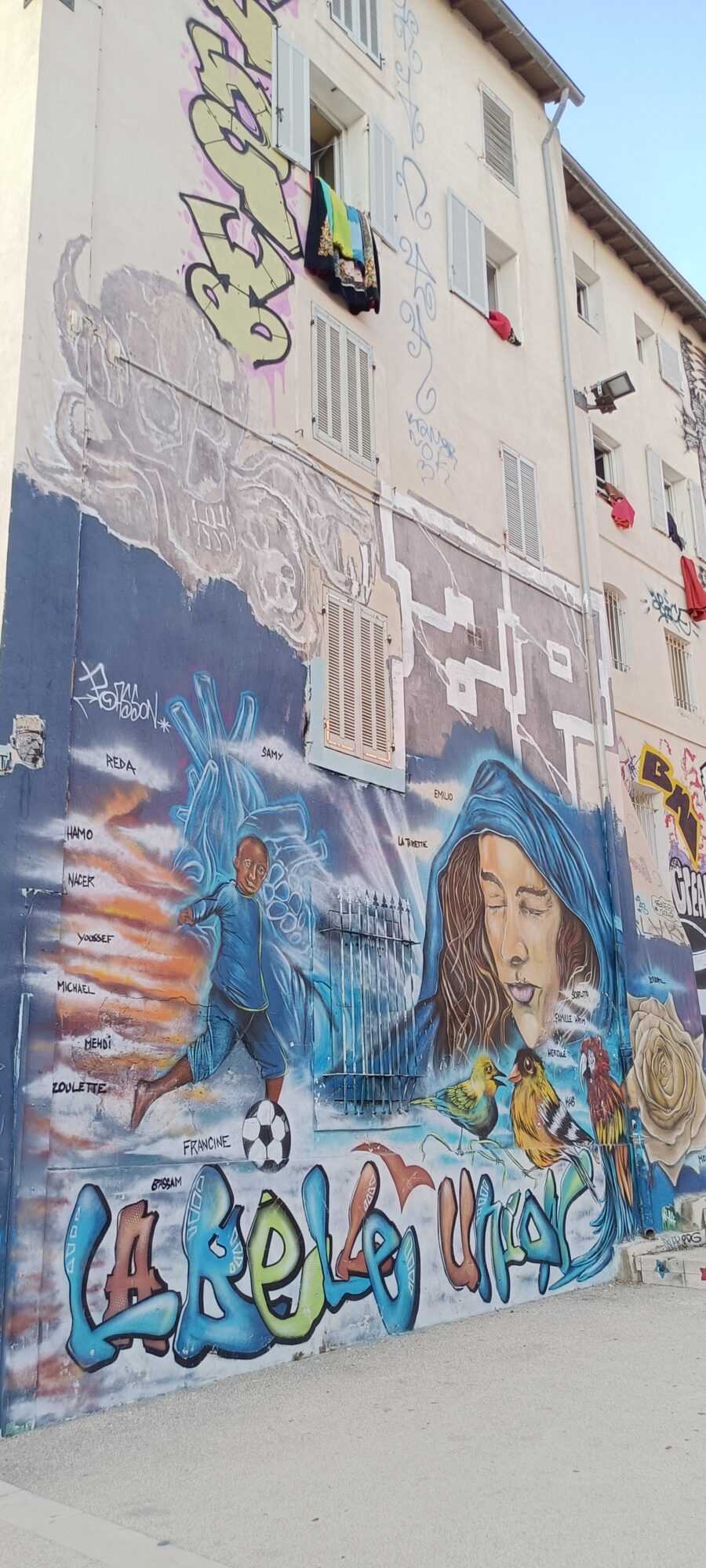
Le Panier stands on the site of Greek Massalia, founded around 600 BCE on the northern shore of the Vieux-Port. Being the oldest quarter in town is not a piece of scenery here. Its narrow lanes exist because building beyond the ramparts was forbidden, which forced houses to pile up four or five storeys along passages where two people barely pass each other. That density largely explains the shape street art takes in the area. With few large surfaces available, artists work small: a garage door, an electricity meter, a metal shutter, a flight of steps.
The district's recent history is brutal. Between 22 and 24 January 1943, the German authorities and the Vichy regime evacuated and then dynamited the neighbouring Saint-Jean quarter. Around 30,000 residents were expelled, several thousand arrested and deported, and close to 1,500 buildings destroyed. Only the 16th-century Hôtel de Cabre was left standing, later moved on hydraulic jacks. Le Panier emerged from the war poor and insalubrious, and stayed that way for decades. Rehabilitation programmes, the arrival of artist studios, then the Euroméditerranée development and the fame brought by the TV series Plus belle la vie have accelerated its transformation, along with the gentrification tensions that come with it.
Street art took hold in Marseille in the 1980s in the wake of hip-hop culture, followed in the next decade by a scene led by IAM and Fonky Family. In Le Panier the practice took a particular turn: most walls are painted with the agreement of shopkeepers and residents of the building. Locals maintain the murals, clean them when they degrade, and plant the streets around them. This is negotiated urban art rather than clandestine work, and it shows in how long pieces survive. A Le Panier mural often stays in place for years, where an open wall elsewhere gets covered within weeks. That stability is also why the district reads as a curated set rather than a churn of tags, and why guided tours run here by graffiti artists themselves have become a fixture.
Top street art spots in Le Panier
The Invader mosaic on Montée des Accoules
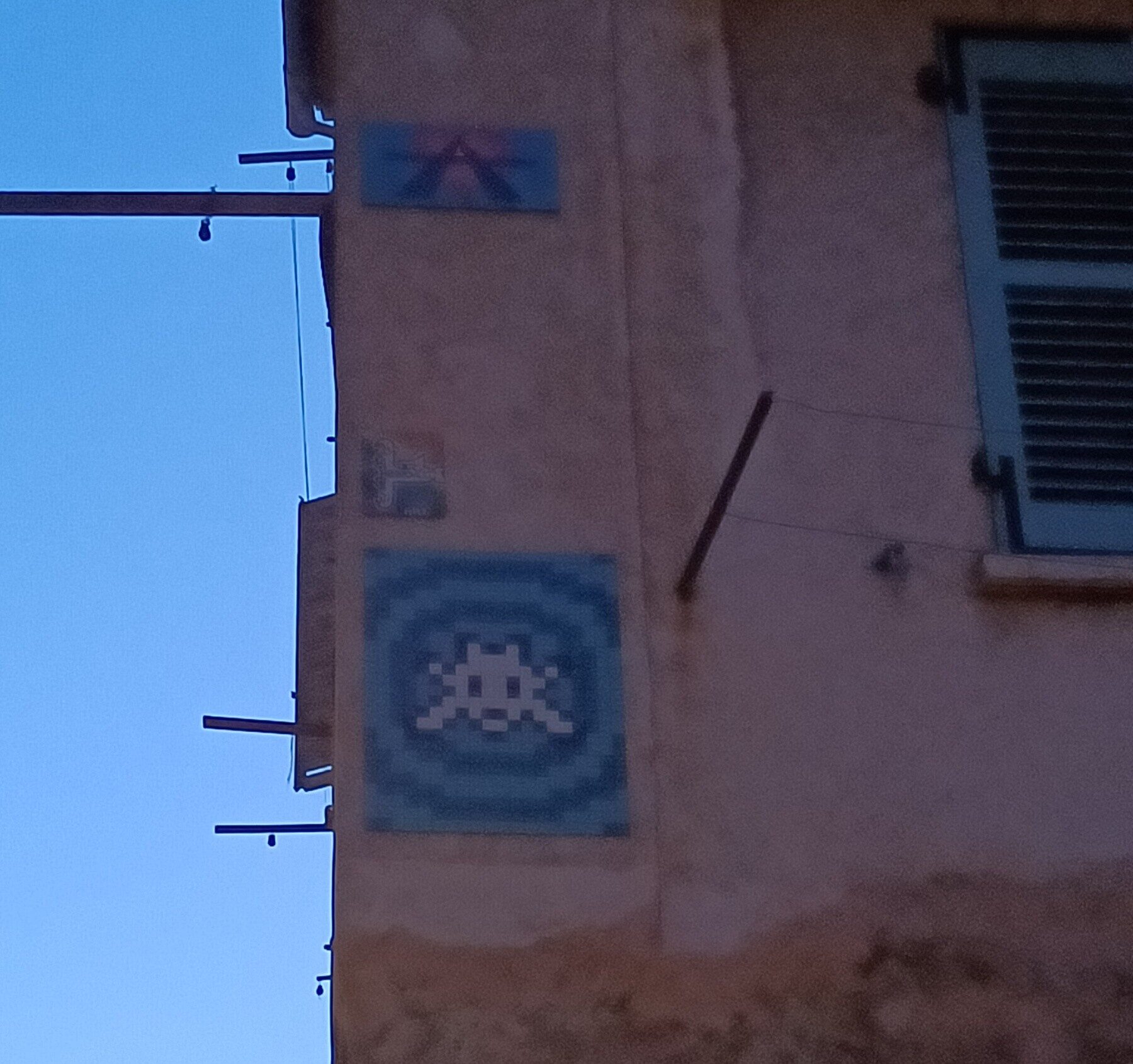
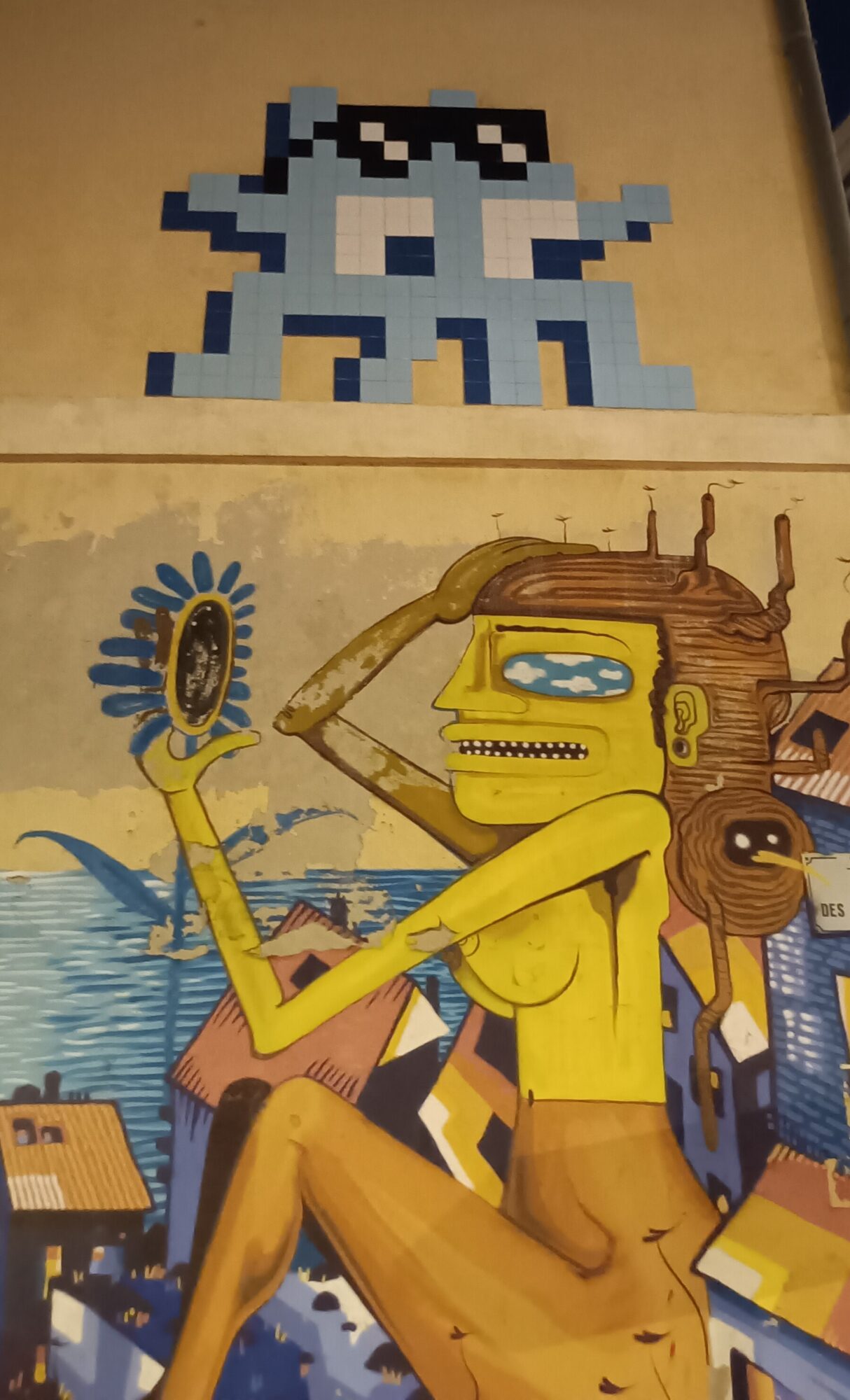
Invader has been scattering tile mosaics across more than a hundred cities since the late 1990s, and Marseille holds several series. This one, shaped like a target, sits high up on the Montée des Accoules, the stairway climbing from Rue Caisserie. Spotting it means looking up, which is the whole point with this artist, who deliberately places pieces out of reach. A sticker by A2 has settled right next to it. See the artwork page for the exact position.
Ami Pêcheur, Place des Pistoles
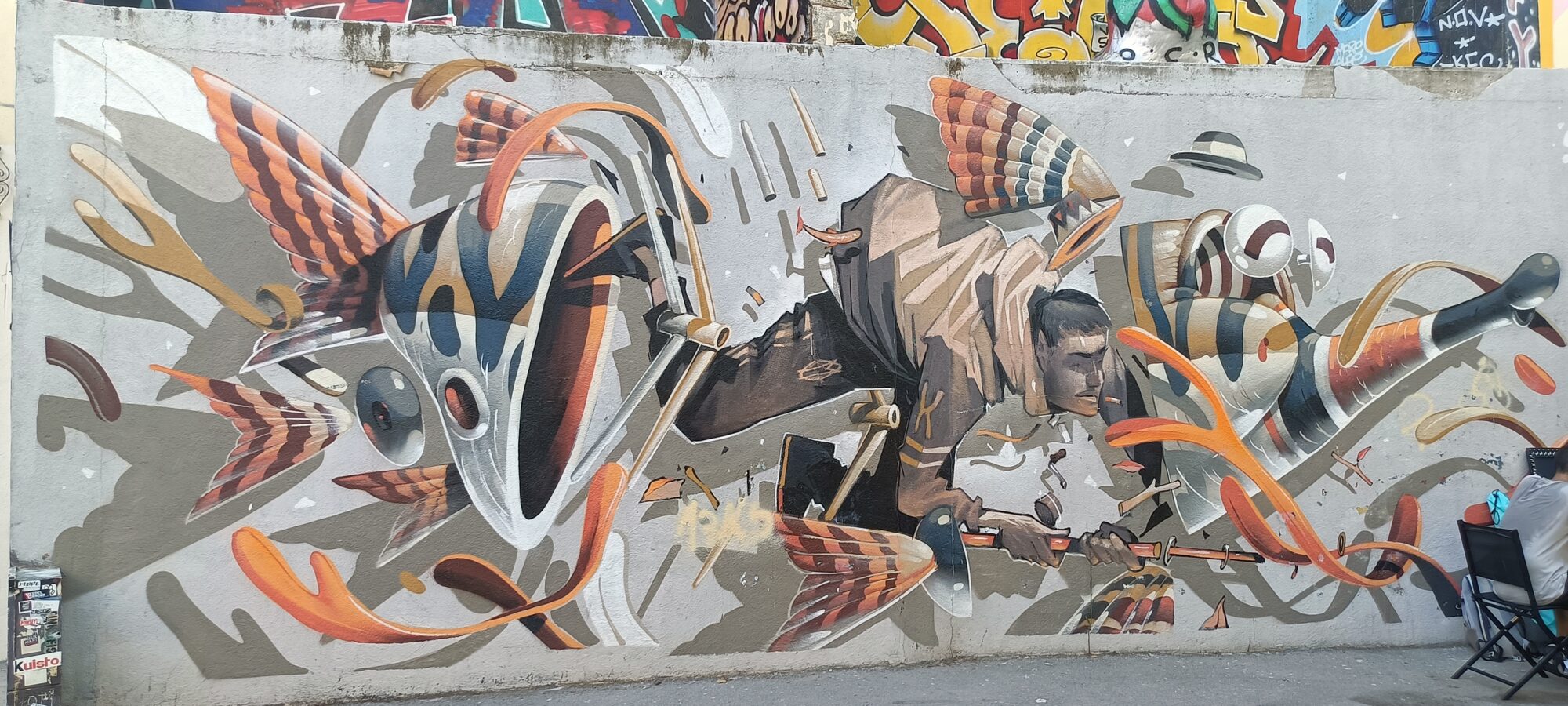
Place des Pistoles, at the foot of the Vieille Charité built to Pierre Puget's plans, gathers several large painted facades. Ami Pêcheur is a four-handed piece by Difuz and Stom500. The fisherman is a recurring motif in Marseille street art, where the harbour is never far from the subject matter, and the graphic treatment stands apart from the more figurative work elsewhere on the square.
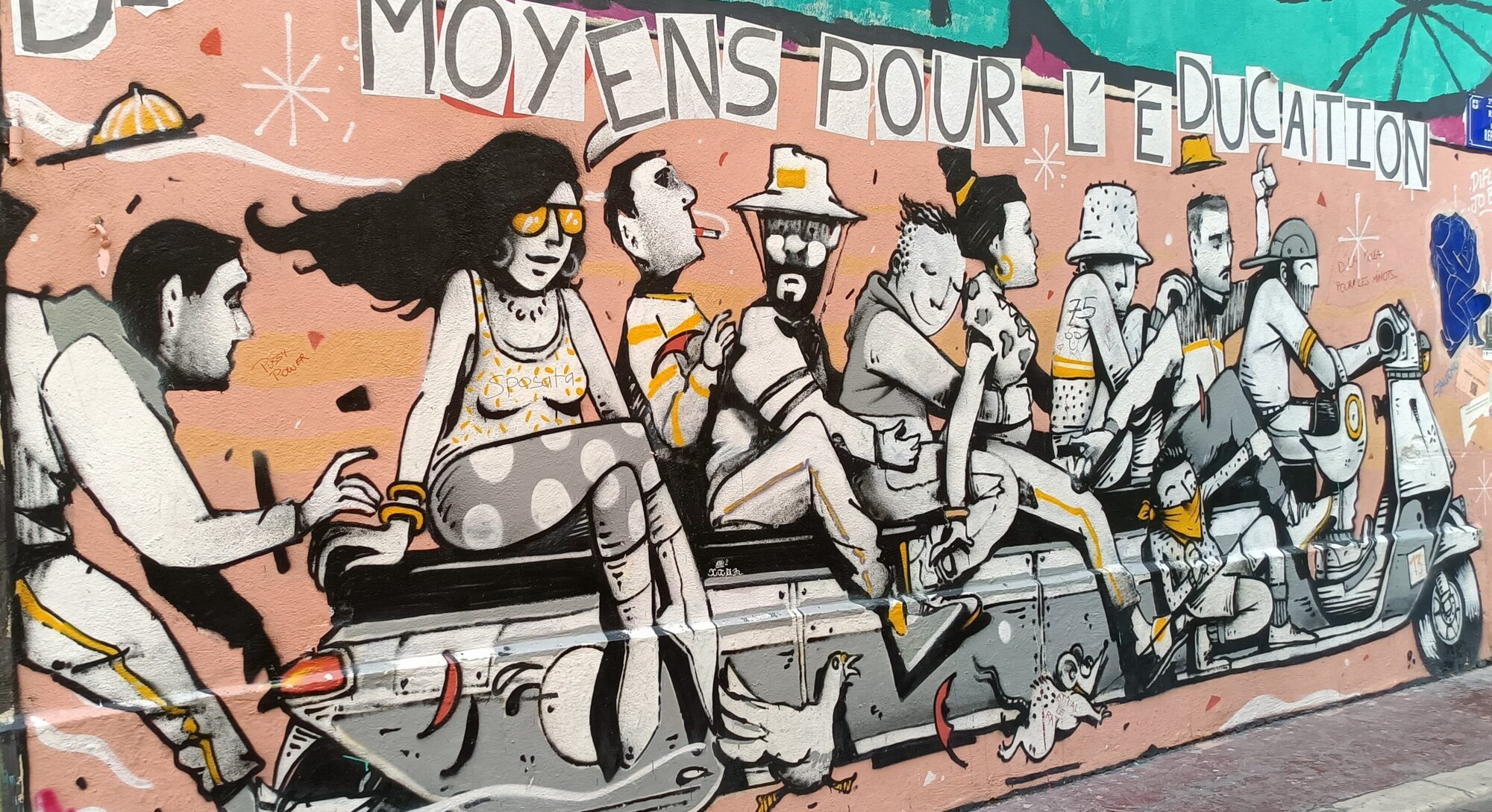
Nhobi's cycling lovers, Rue du Petit Puits
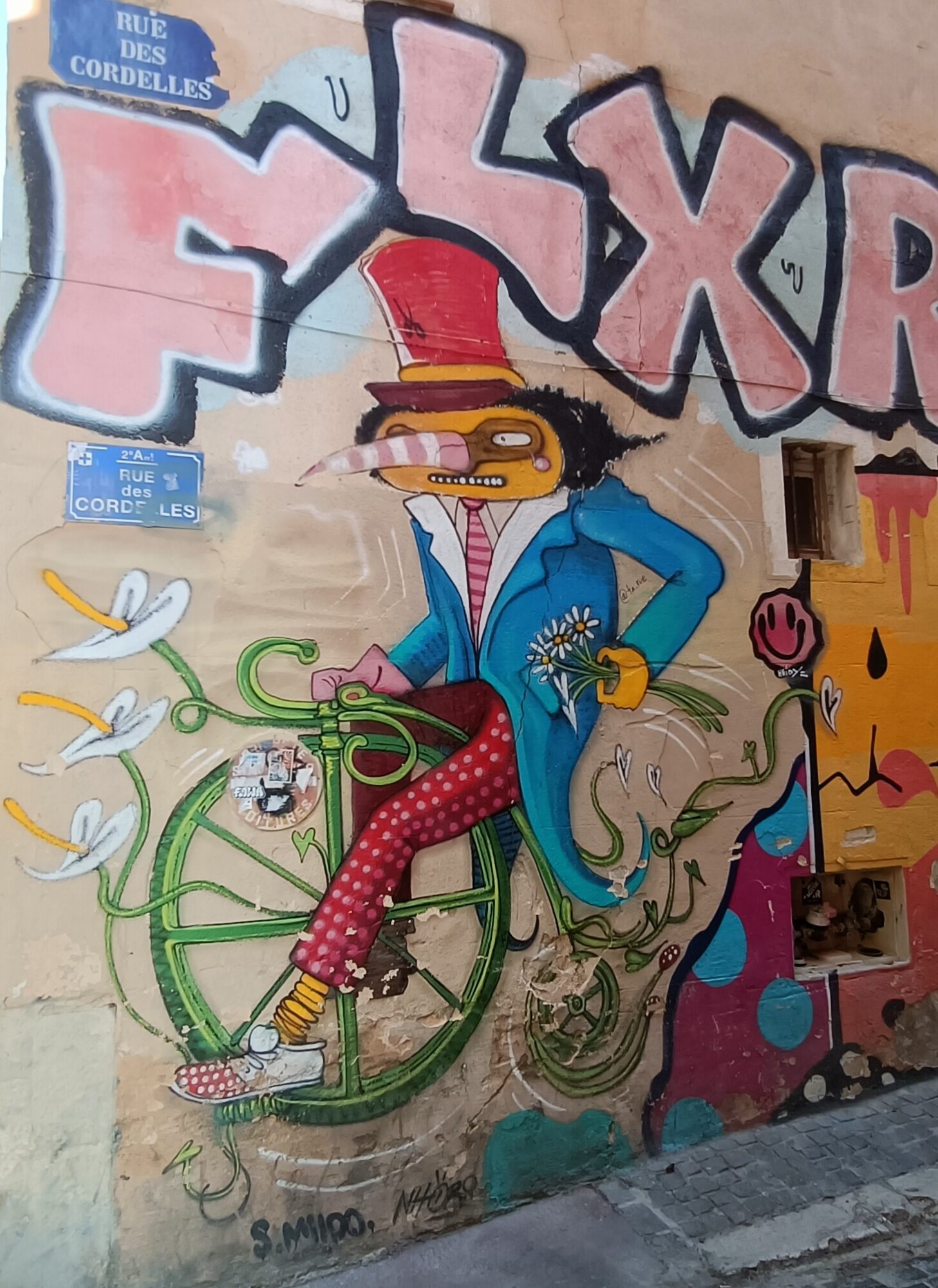
Nhobi, a Brazilian artist based in Marseille, is the most present name in the district with six geolocated pieces inside our radius. His grimacing faces and bulging eyes are recognisable at a glance. Rue du Petit Puits, which opens onto Place des Pistoles, holds several of them, including these cycling lovers. He also appears on the Montée des Accoules alongside Seek313 on a mural named after a local proverb.
Poasson's underwater wall, Rue des Mauvestis
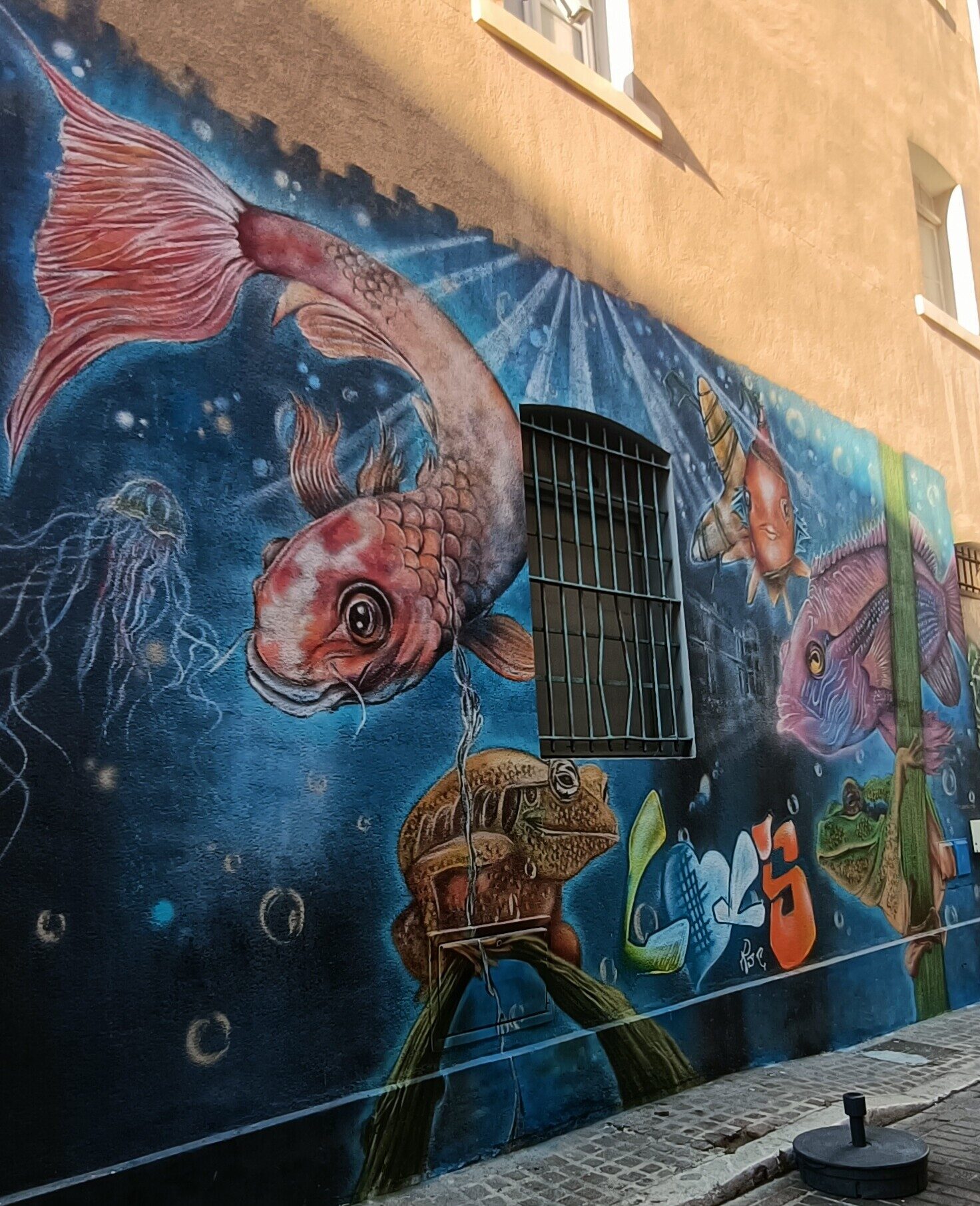
Poasson paints Rue des Mauvestis in sequence: koi carp, jellyfish, a reef. The set reads while walking rather than standing in front of a single piece. It is a good example of what the layout of Le Panier allows, where a narrow lane becomes a continuous surface instead of one isolated wall. The same artist signs a Jungle Jam with a gramophone two streets away on Rue Saint-Antoine.
La Dactylo's La Vague à l'Âme, Place des Augustines
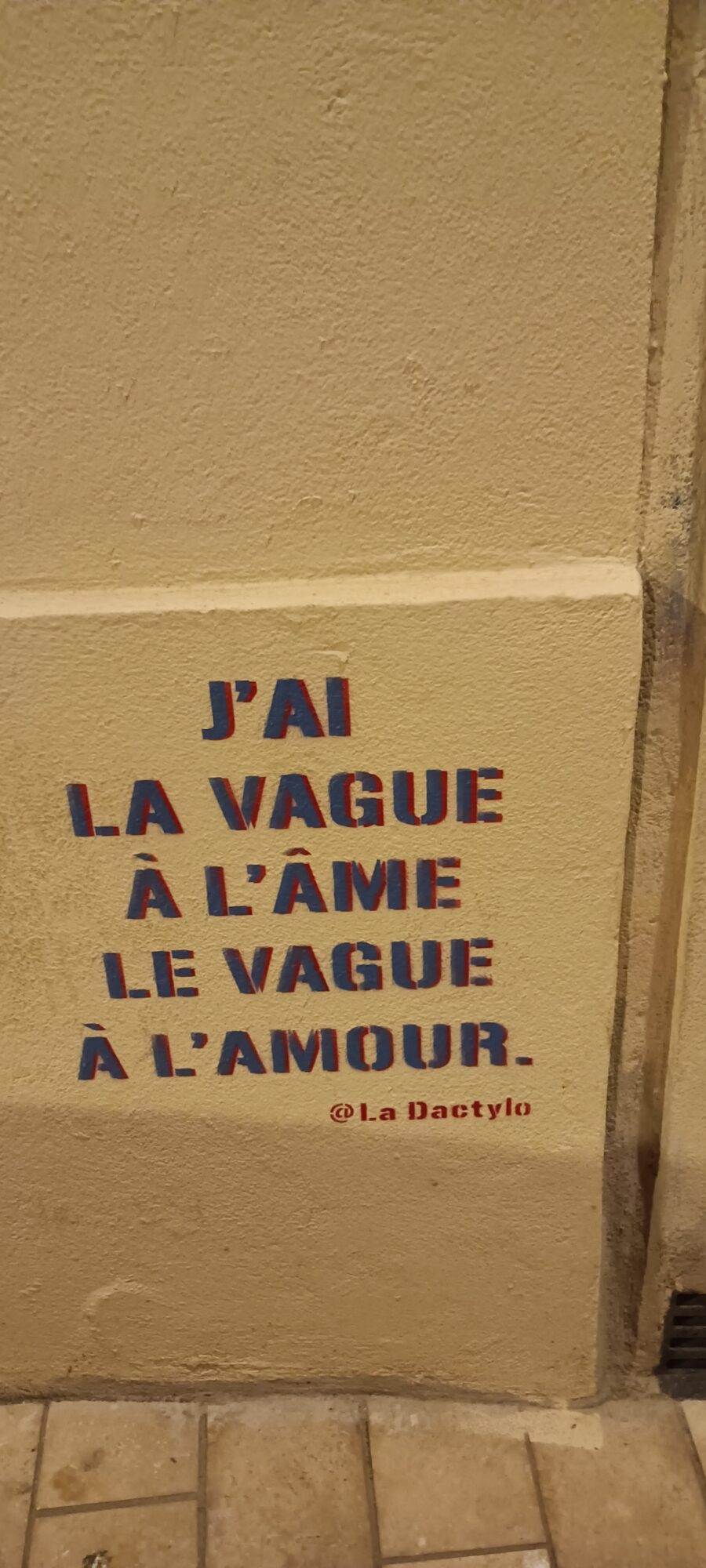
La Dactylo works with text as much as image, and the painted wordplay is part of the district's visual vocabulary. Place des Augustines, slightly off the tourist flow, brings together three of these pieces alongside Invader mosaics and cubist figures by Nhobi. It is one of the densest points on the route and one of the quietest.
Manyoly's brushwork portrait, Rue du Chevalier Paul
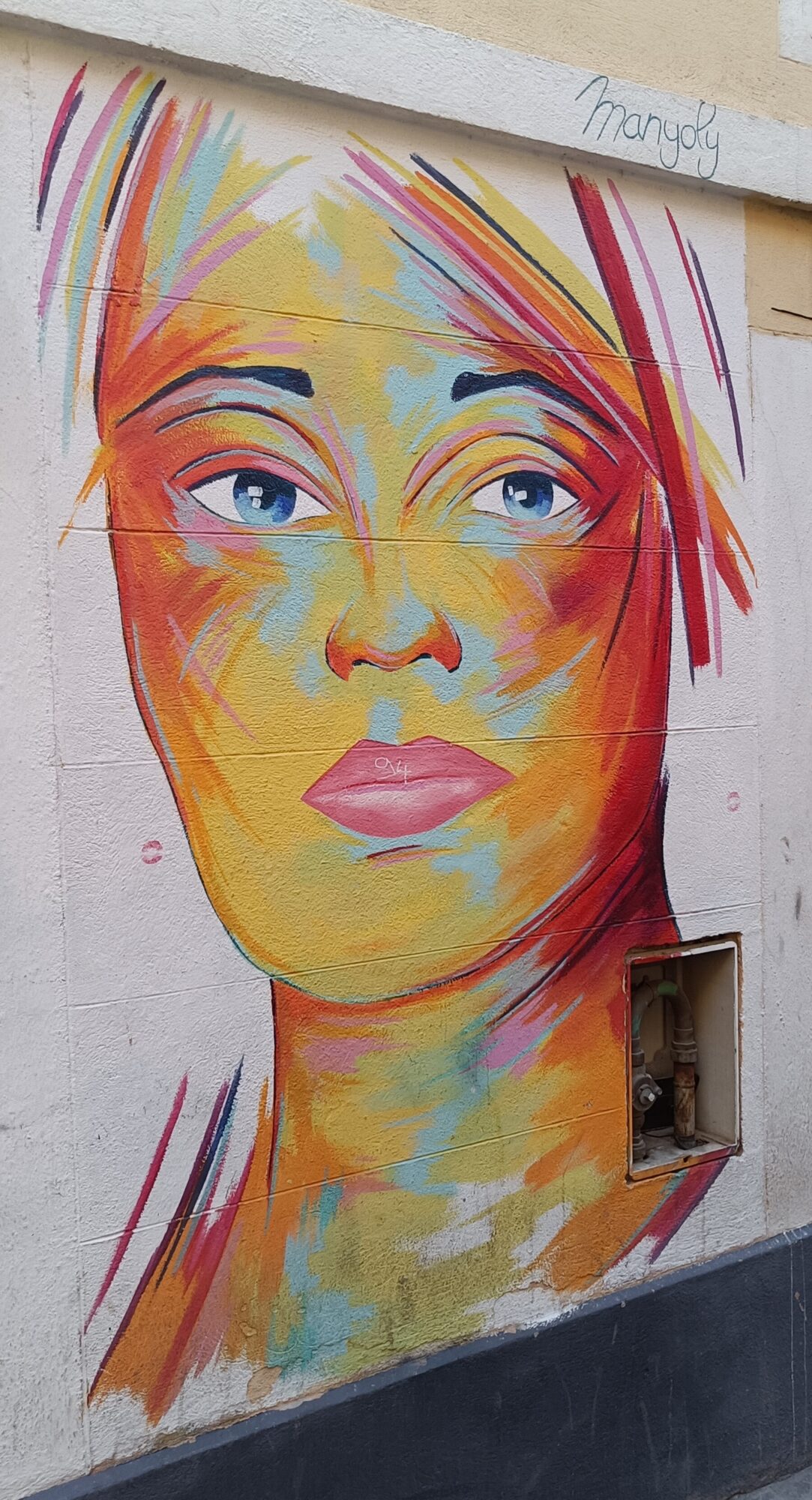
Manyoly discovered street art in Marseille, and the female portraits built from flat blocks of bright colour have since been painted in Murcia and London. This one is on Rue du Chevalier Paul, on the northern edge of the district, slightly beyond the usual circuit. It is the spot that asks for the most walking, and the one with the fewest people around.
Place de Lenche, the district's collective wall
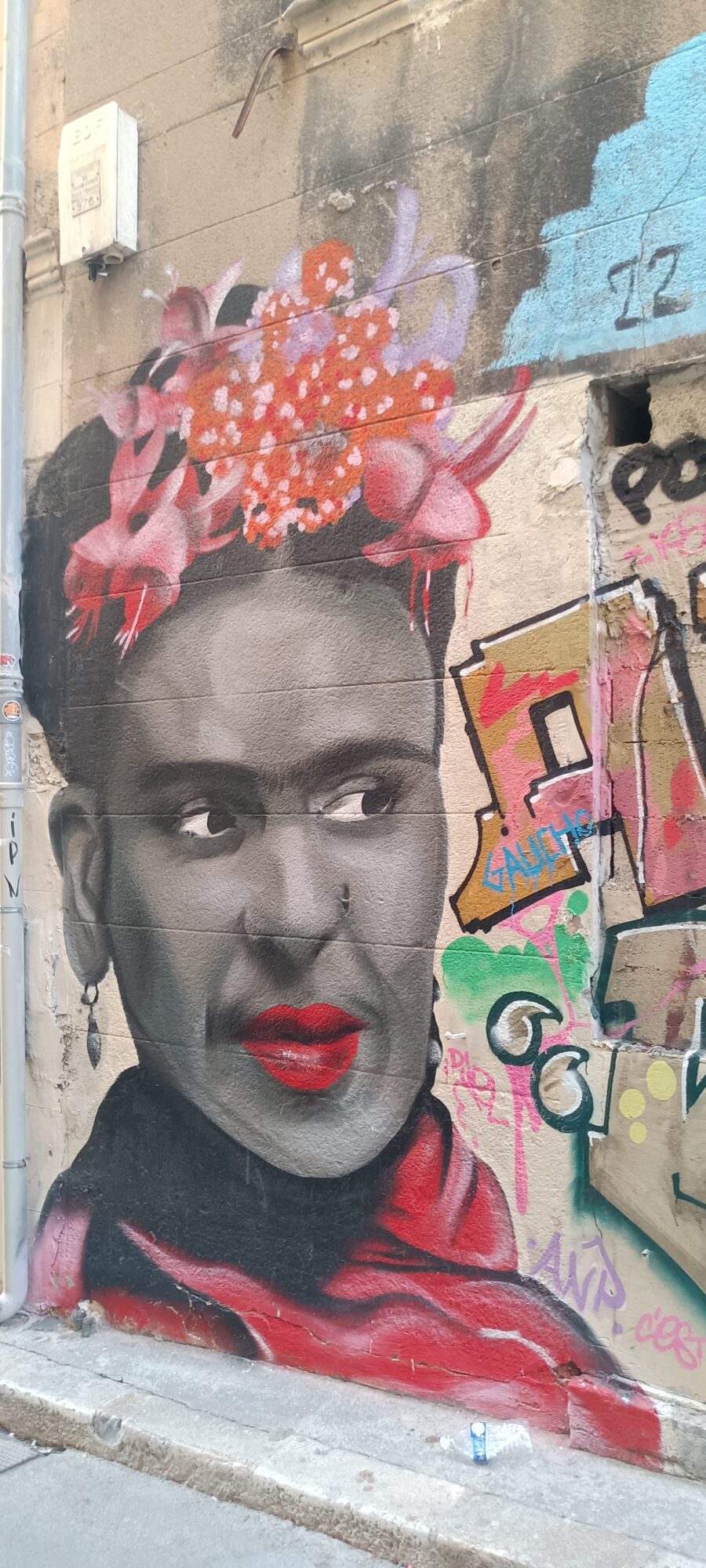
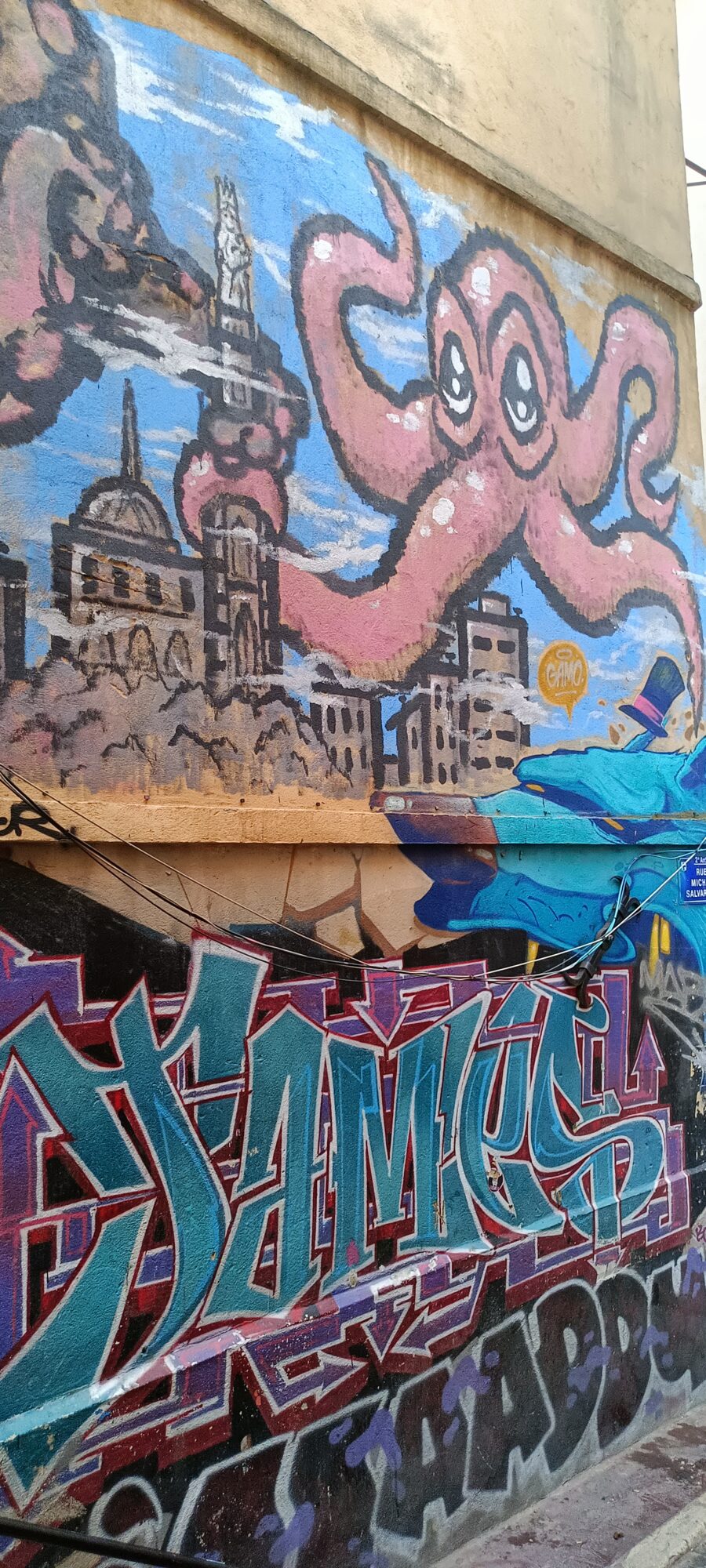
Place de Lenche stands on the former Greek agora, later the Roman forum. It is now the densest point in Le Panier: we have recorded 37 artworks along a single run of walls, signed by ANP, La Dactylo, Gamo, Difuz, Nhobi, Manyoly, Kitsa, Ekors, Deuz and A2, plus a set of unattributed pieces. The wall works as a collective board where formats follow one another with no visible hierarchy, from the Frida Kahlo portrait to Gamo's pink octopus wrapped around the city. Keep this stop for the end of the route: on its own it sums up what the district does.
Artists associated with the neighbourhood
These are the signatures that come up most often inside the perimeter, ranked by the number of pieces we have recorded.
- Nhobi - six pieces in the radius. Expressive characters, distorted faces, saturated palettes. The most visible signature in the district.
- Difuz - five pieces. Crowd scenes and collective compositions, often collaborative.
- Invader - five mosaics. The only one here who does not paint: glued tile placed high, to be found above eye level.
- Poasson - five pieces. Marine life in sequence, on Rue des Mauvestis and Rue Saint-Antoine.
- La Dactylo - three pieces. Painted text and wordplay, on Place des Augustines and Place de Lenche.
- A2 - three pieces. Glued hearts and pictograms, usually at the margin of a larger mural.
- Manyoly - two female portraits in flat colour blocks.
- ANP - two portraits, including a Frida Kahlo on Place de Lenche.
- Gamo - a pink octopus wrapped around Marseille, on Place de Lenche.
- Gzup - cut-out paste-ups, including an octopus on Rue Saint-Antoine.
Beyond murals: mosaics, paste-ups and stencils
Reducing Le Panier to painted walls would mean missing half the district. Invader mosaics have been up for years and are found by looking upward: a target on the Montée des Accoules, a blue alien and a pastis still life on Place des Augustines. The format brings its own logic, since tile survives rain and cleaning where aerosol fades.
Paste-ups and stickers form the third layer. Gzup cuts figures out before putting them up, and A2 scatters hearts and pictograms at the edge of larger murals. This stacking of techniques within a few hundred metres is what sets Le Panier apart from Cours Julien, where the painted wall dominates. Here a single facade can carry a mural, a paste-up and a mosaic, applied years apart.
How to visit Le Panier
The district is a short walk from metro Vieux-Port (line 1) or Colbert / Hôtel de la Région (line 1), and from Joliette (line 2) on the northern side. By tram, lines T2 and T3 stop at Sadi Carnot and République Dames. A good starting point is the Montée des Accoules for the Invader mosaic, then Place des Pistoles and Rue du Petit Puits, Rue des Mauvestis, and finally Place des Augustines. Allow two hours at a slow pace, more if you go hunting for mosaics. The gradient is real, so bring shoes that handle cobbles and stairs.
To plan the walk, the Marseille street art map locates every piece before you set off, and the full list of Marseille artworks also covers Cours Julien, La Plaine and Le Panier. If this kind of district appeals to you, our guides to Belleville in Paris, Shoreditch in London and El Carmen in Valencia follow the same approach.
Missing a piece, or found a mural that has been painted over? Le Panier moves fast and our records age. You can add an artwork in a couple of minutes, with its photo and position.
Back to blog