
Street Art at Darwin (Bordeaux): 2026 Guide
8 September 2026
On the right bank of the Garonne, a ten-minute walk from the Pont de Pierre, the former Niel barracks holds what is probably the highest concentration of mural painting in Bordeaux. Now known as Darwin, this cluster of converted military buildings gathers more than a hundred mapped works, nearly all of them within a perimeter you can cover on foot in an hour.
From army barracks to painting ground
The story starts on 5 December 1874, when the French state bought land on the right bank to consolidate its military services. The Niel barracks was completed in 1877 for the 18th squadron of the train des équipages, and two general warehouses, built in the 1850s, completed the compound. The site covers roughly twenty thousand square metres.
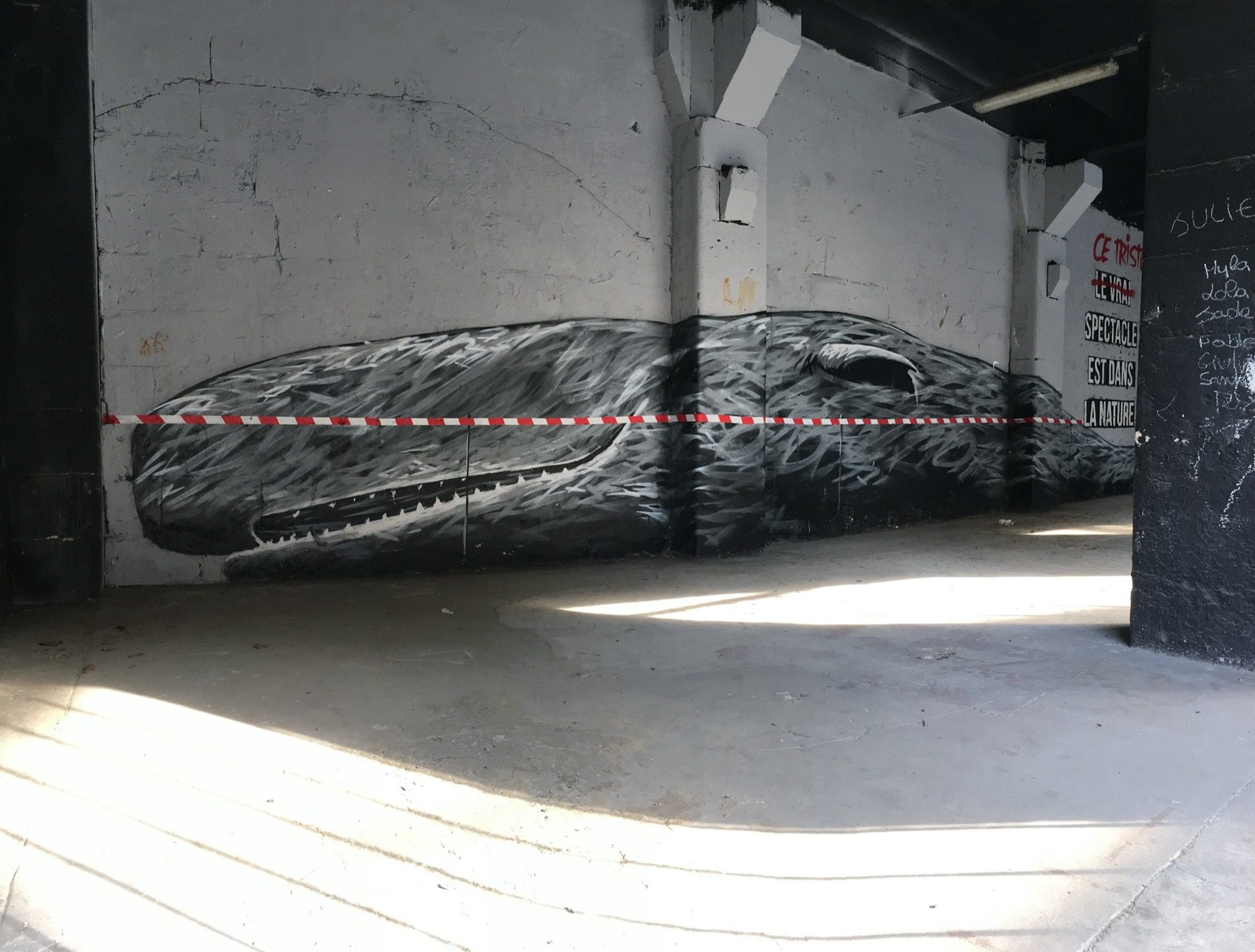
The army left in 2005. For several years the disused hangars and gutted buildings formed an open wasteland by the river, and that wasteland quickly became one of the main graffiti grounds in Bordeaux. Walls were covered with no permission and no programme. That oldest layer is still visible under the recent murals, in stairwells and on the least accessible facades.
In 2009, Darwin Evolution bought 10,000 m² of buildings on the northern half of the site, then secured the renovation of the southern warehouses in 2014. The project chose to keep the existing structures rather than demolish them: the former stables now house a coworking space, a startup incubator focused on sustainability, an organic grocery, a restaurant, an urban farm, an Emmaüs second-hand store and an indoor skatepark. The site draws more than a thousand people a day and hosts some 230 businesses. The painting never stopped.
The best street art spots at Darwin
The site reads in three parts. The northern buildings, along the quay, offer the largest painted surfaces. The southern buildings, around the warehouses and the skatepark, are the ones that change fastest. And the streets bordering the compound, rue Hortense and rue du Maréchal Niel, are usually left out of visitors' routes even though they hold some of the strongest pieces. Here are eight to look for.
Rast's Hollywood diptych on rue du Maréchal Niel
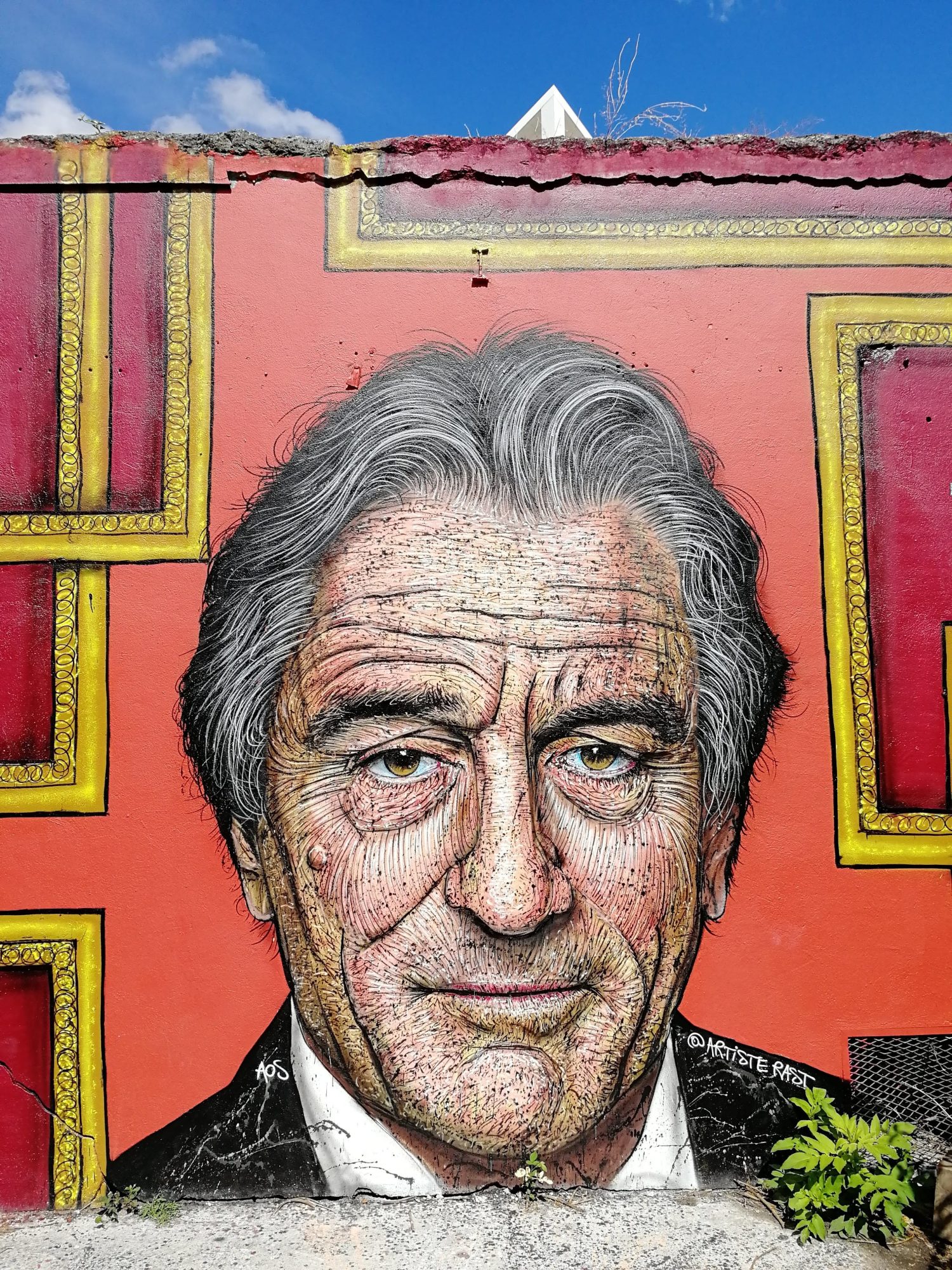
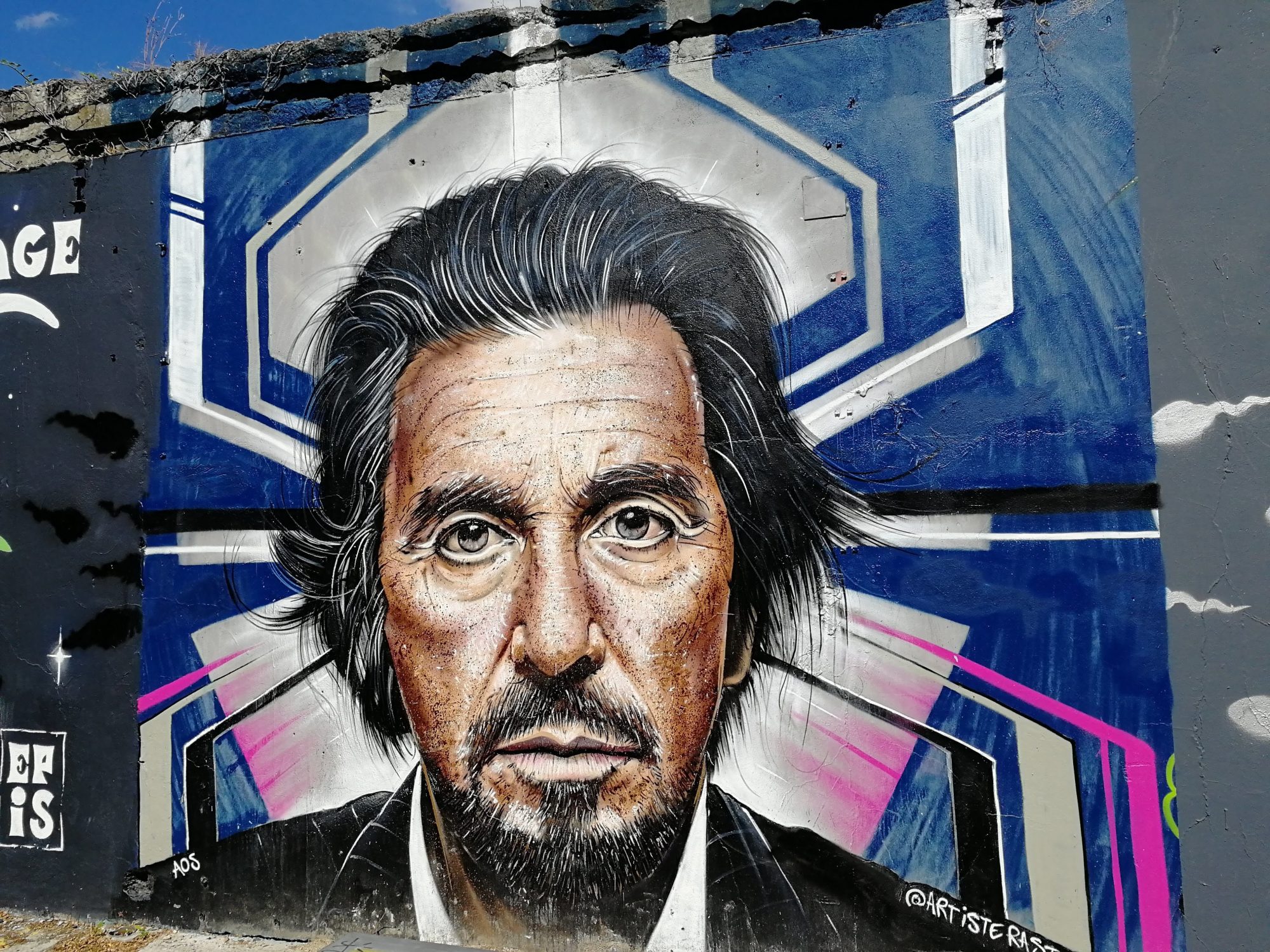
Two hyperrealistic portraits answer each other on the same wall of rue du Maréchal Niel. Robert De Niro stands against a red background lined with trompe-l'oeil gilded frames, Al Pacino against a blue one streaked with geometric lines. Signed by Rast, both faces are worked wrinkle by wrinkle, to the point where the skin texture seems carved into the wall. It is the easiest spot to miss: you have to leave the compound and follow the street to the west.
Alber, from protest lettering to cubist portraits
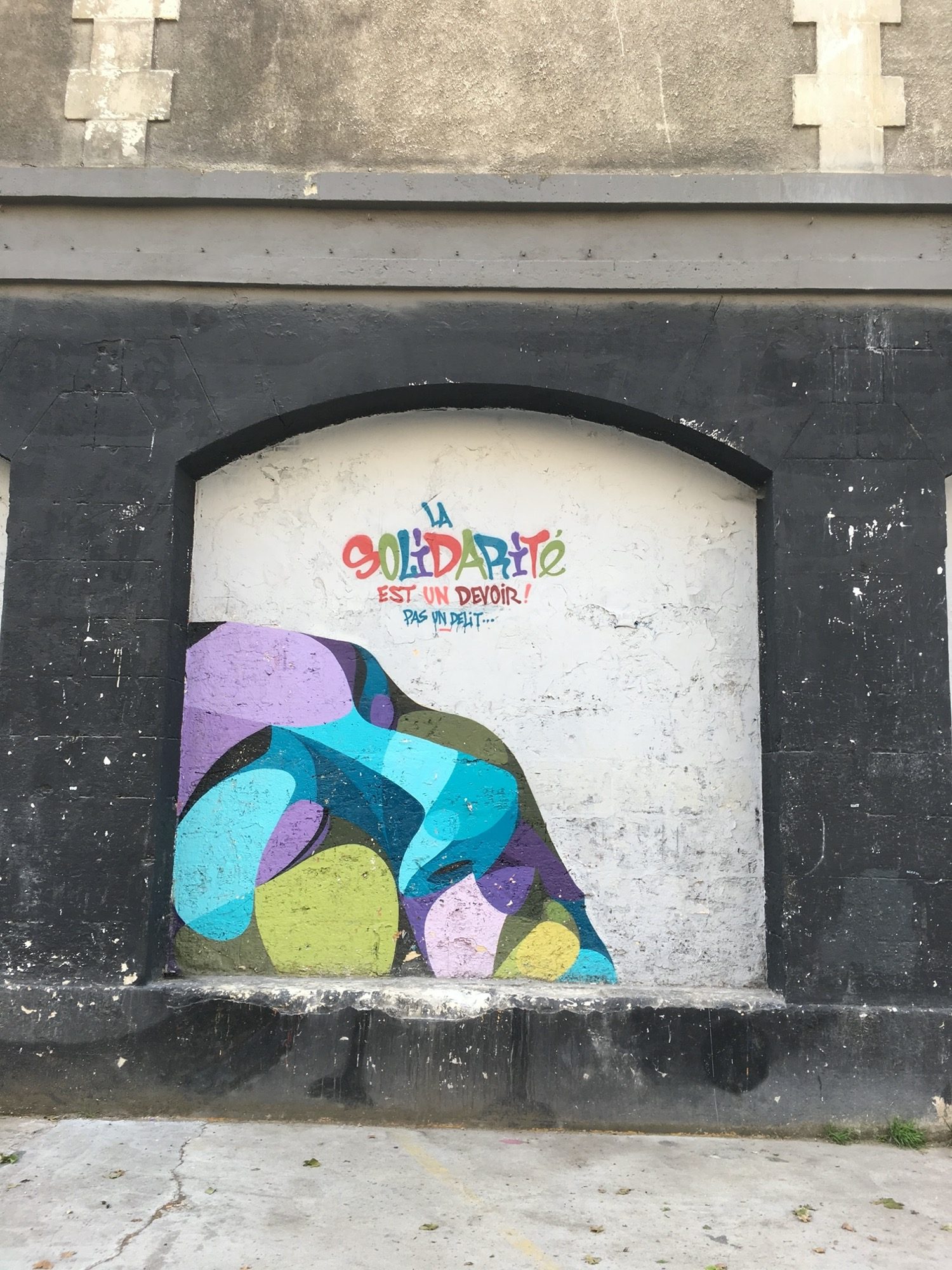
Alber works in two registers here. In a recess along quai des Queyries he writes "solidarity is a duty, not a right" in colourful lettering above an organic shape in flat turquoise, green and purple. A few dozen metres away he covers a long low wall with an enormous female face broken into geometric facets that runs its full width. That mural, co-signed Humes, is dated 2017.
"Les Belles et la Bête", the collective wall by Hopare, Lélé and MAS
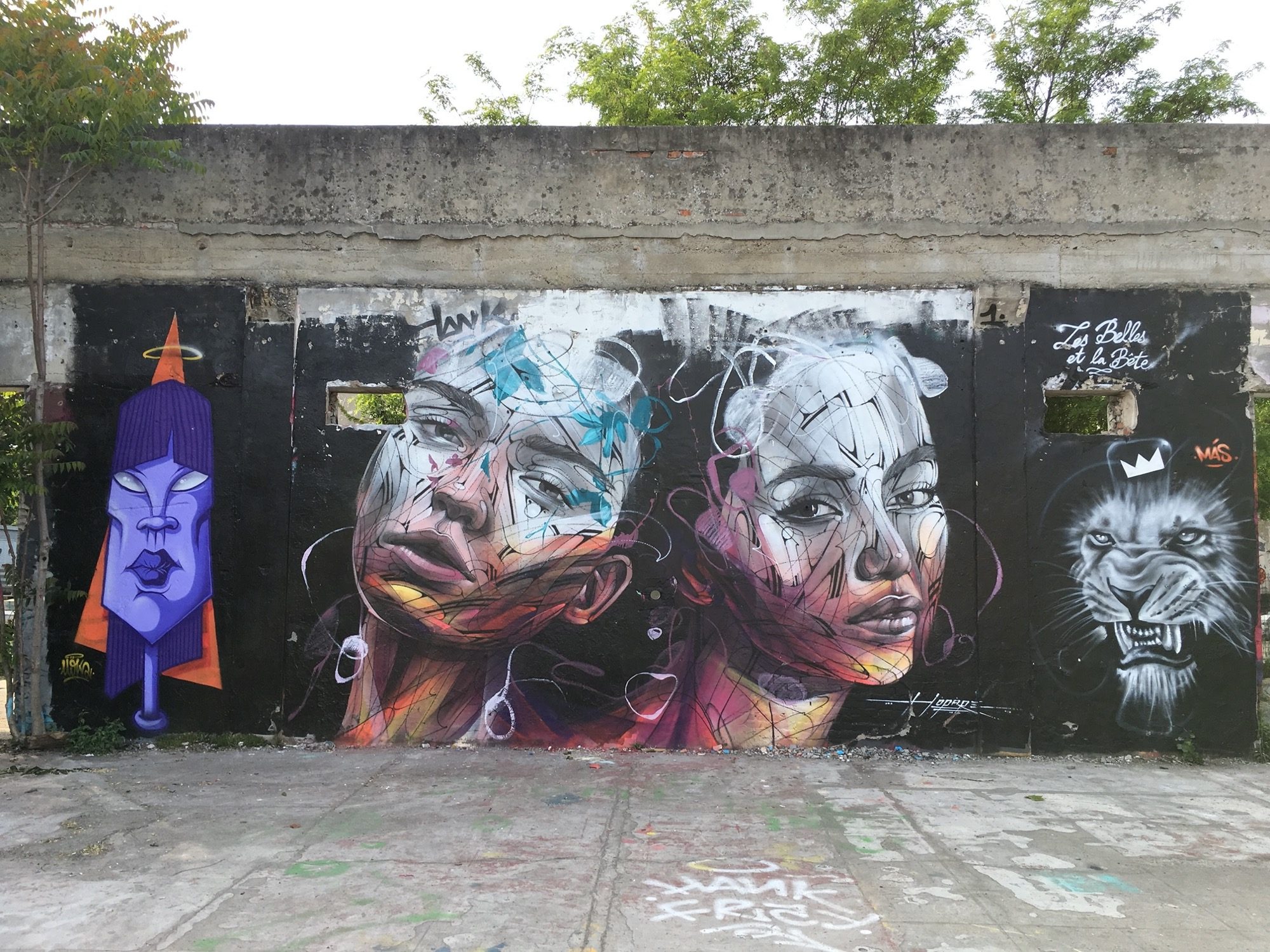
This is one of the few walls at Darwin to carry its own title, "Les Belles et la Bête", hand-painted on the right-hand panel. At the centre, Hopare interlaces two female faces in his signature web of flowing lines, in pinks and mauves on black. On the left, a purple totem with a golden halo by Lélé closes the composition, and on the right a crowned lion by MAS answers it in black and white. The wall reads as a single piece, which is rare on a site where each artist takes their own surface.
"Amazonia" by Epis, the climate wall
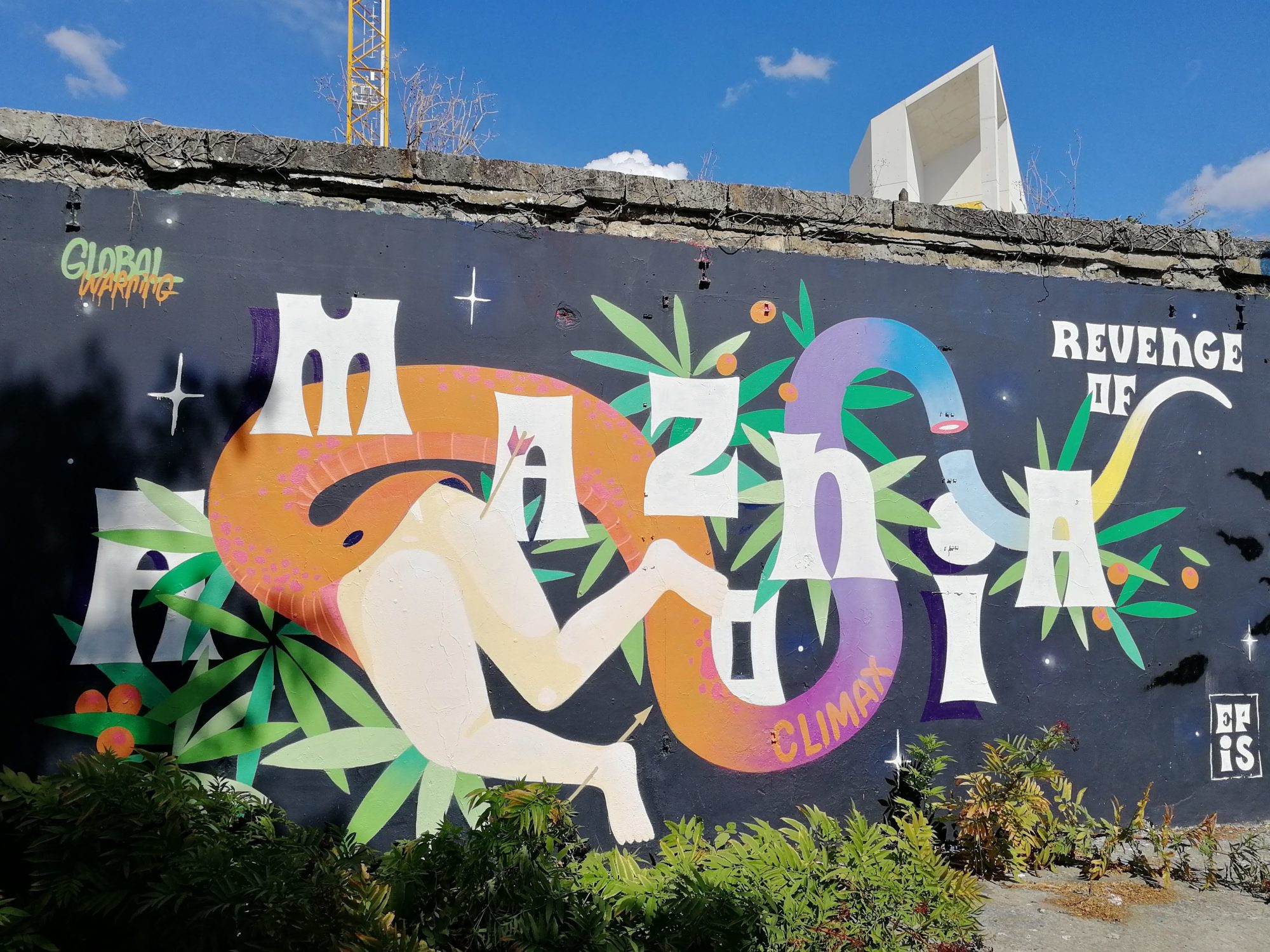
Epis combines massive white lettering, a nude human figure and flat green tropical foliage on a midnight blue ground. The words "Global Warming" and "Revenge of" turn the mural into an ecological statement, and "Climax" painted below the lettering points to the environmental festival Darwin hosts every September. Above the wall, the white silhouette of a new building is a reminder that the Bastide-Niel district is being built all around the site.
See Ya's bestiary
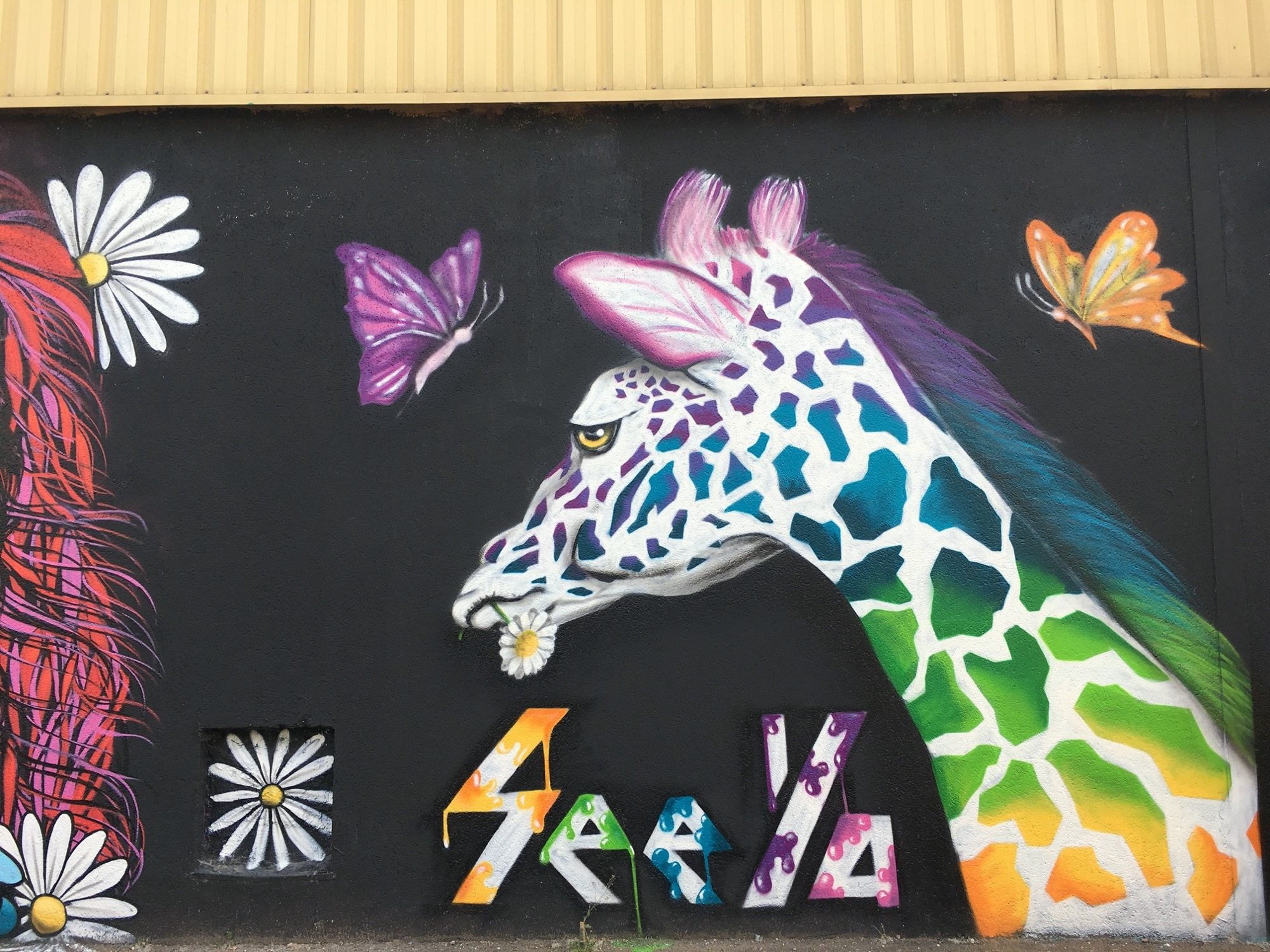
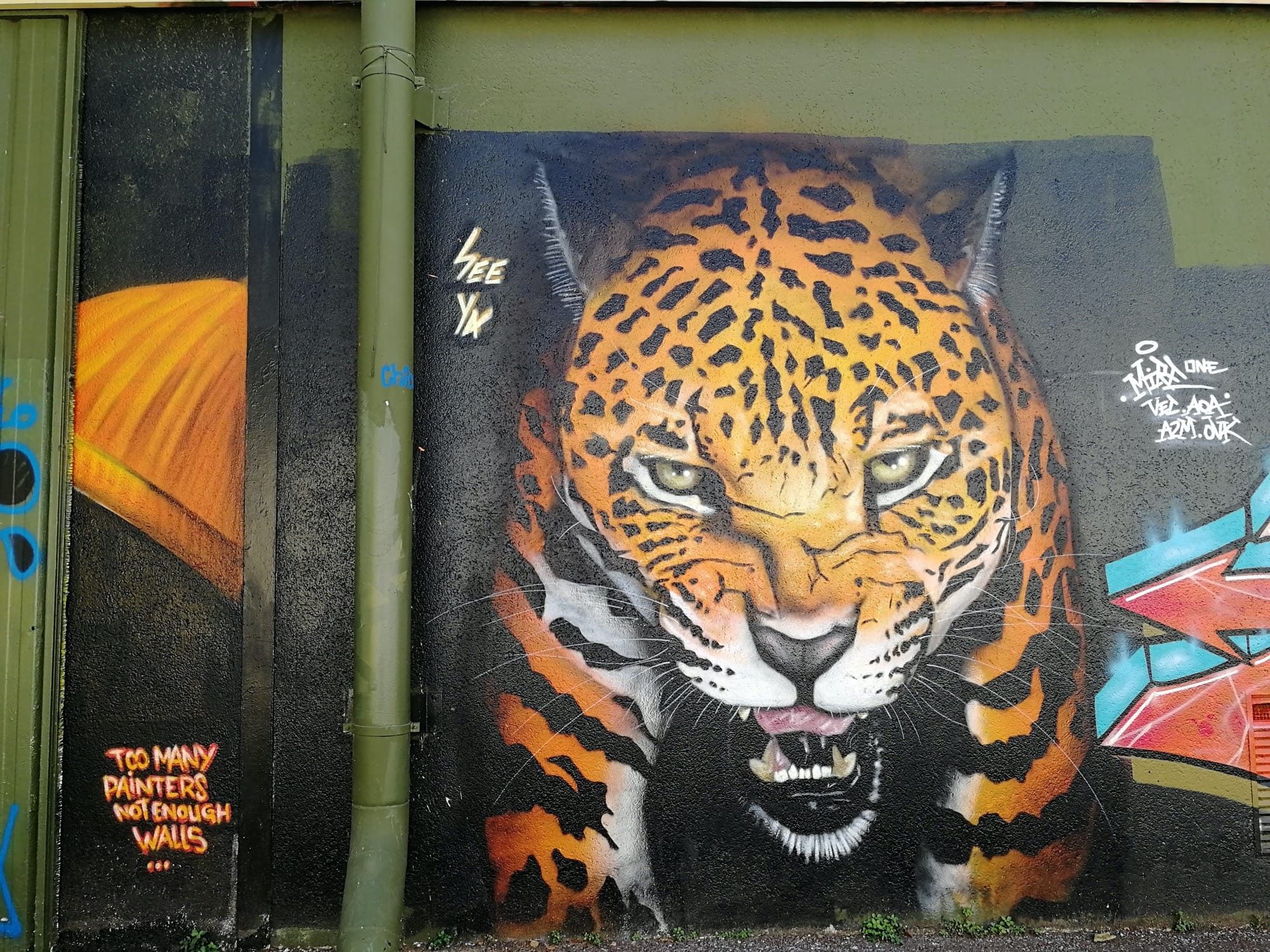
See Ya takes animals in two opposite directions, sometimes only metres apart. On one side a giraffe with rainbow patches holding a daisy in its mouth, surrounded by butterflies, in a frankly dreamlike register. On the other a hyperrealistic tiger, jaws open, in burnt orange. The same artist also signed the "RIP Nemo" piece in the southern building: six salmon maki rolls with a clownfish trapped among them.
Derf and the photorealistic portrait
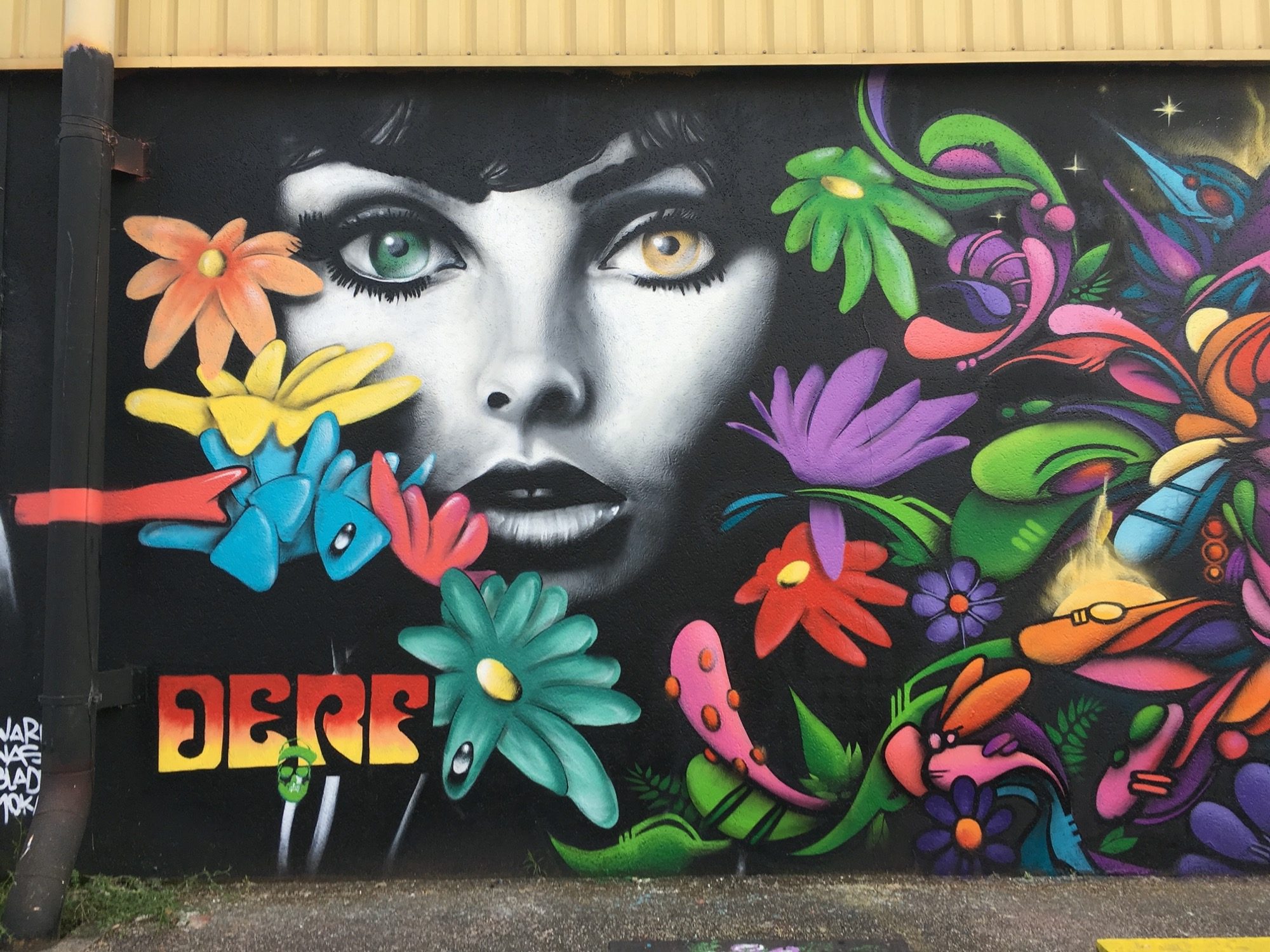
Derf builds his portraits on one simple, effective contrast: a photorealistic face in black and white, ringed by an explosion of tropical flowers in orange, yellow, blue and pink. He signed several pieces on site, including a portrait of a woman with a cross and a face holding a camera on the southern walls.
Freddy and the pink-haired girl, by Abys and Scaf
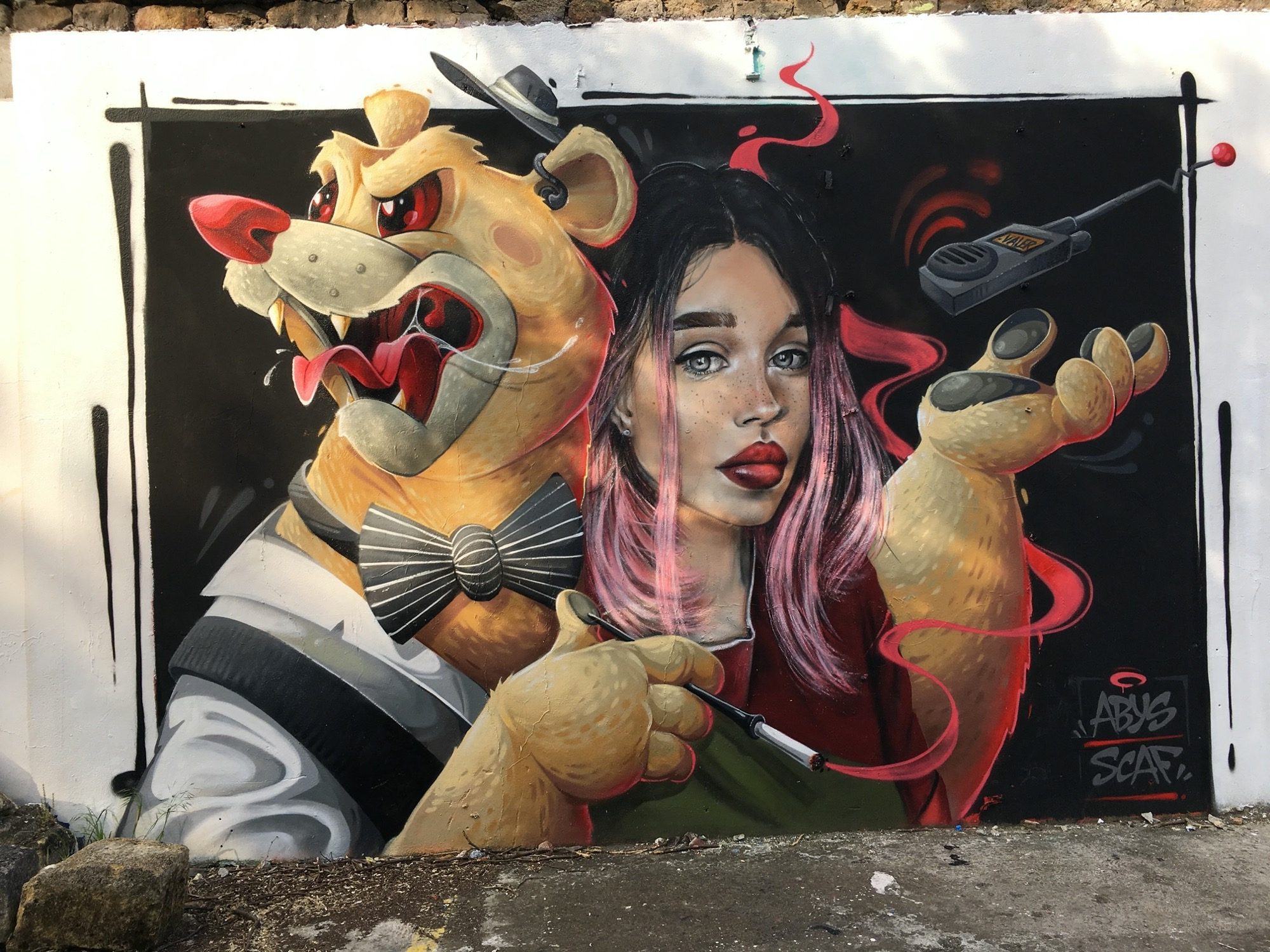
Against a black ground framed by broad brush strokes, a sharp-toothed teddy bear in a hat and striped bow tie holds a young woman with pink hair and red lips. A walkie-talkie and red curls of smoke complete a scene that borrows its character from the video game Five Nights at Freddy's. The mural is co-signed by Abys and Scaf, both regulars on Bordeaux walls.
GZ's pointillist chameleon
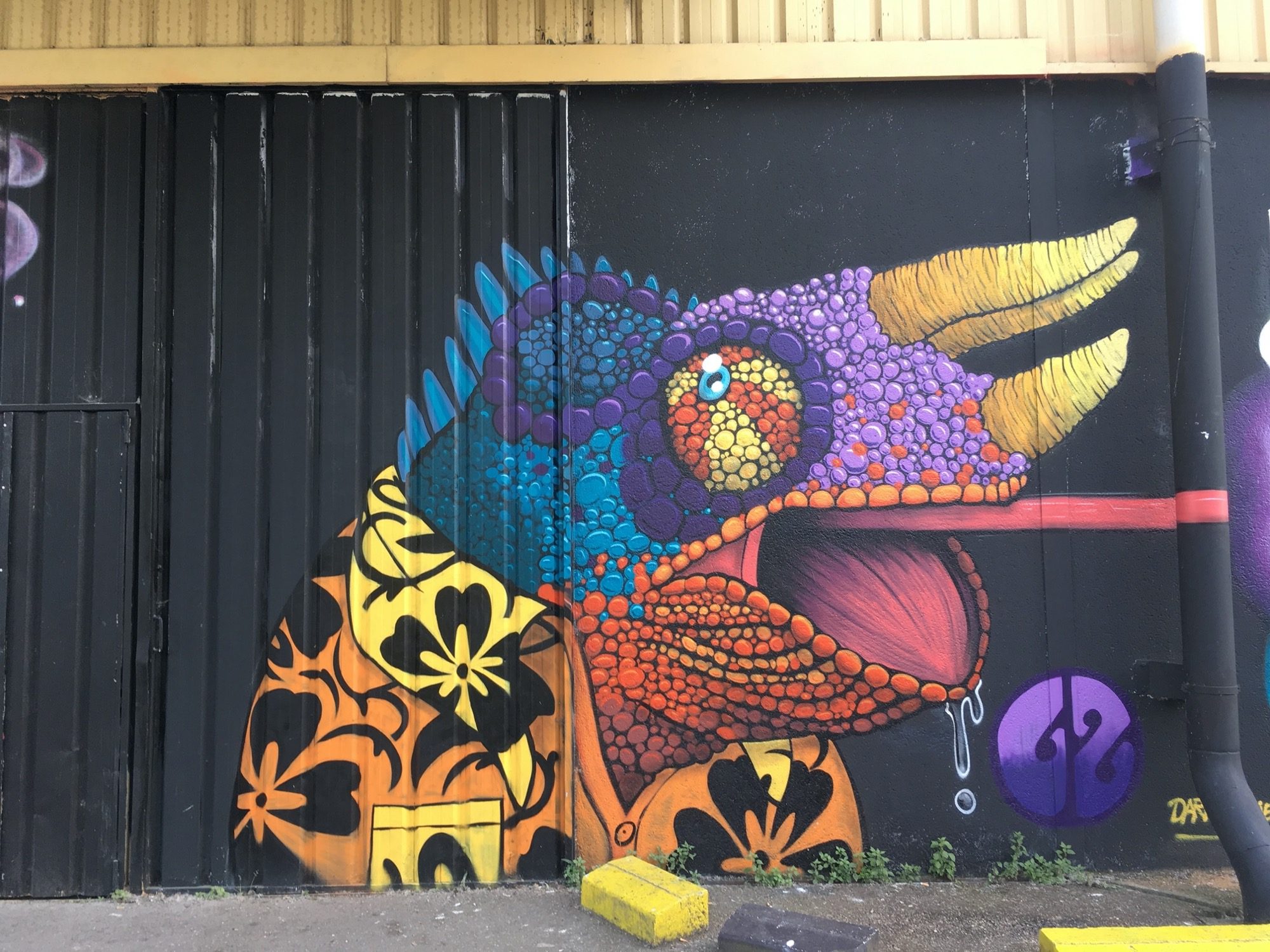
GZ builds his chameleon from hundreds of coloured dots, orange, purple, blue and yellow, laid one by one on black. The technique gives the reptile an almost three-dimensional relief and a body covered in floral patterns. The same artist signed a graphic owl a few steps away.
At Darwin, the walls talk back
What sets Darwin apart from other street art sites is how much room text takes up. Many pieces are not merely decorative: they address the passer-by, with a dry humour that carries on the activist spirit of the place.
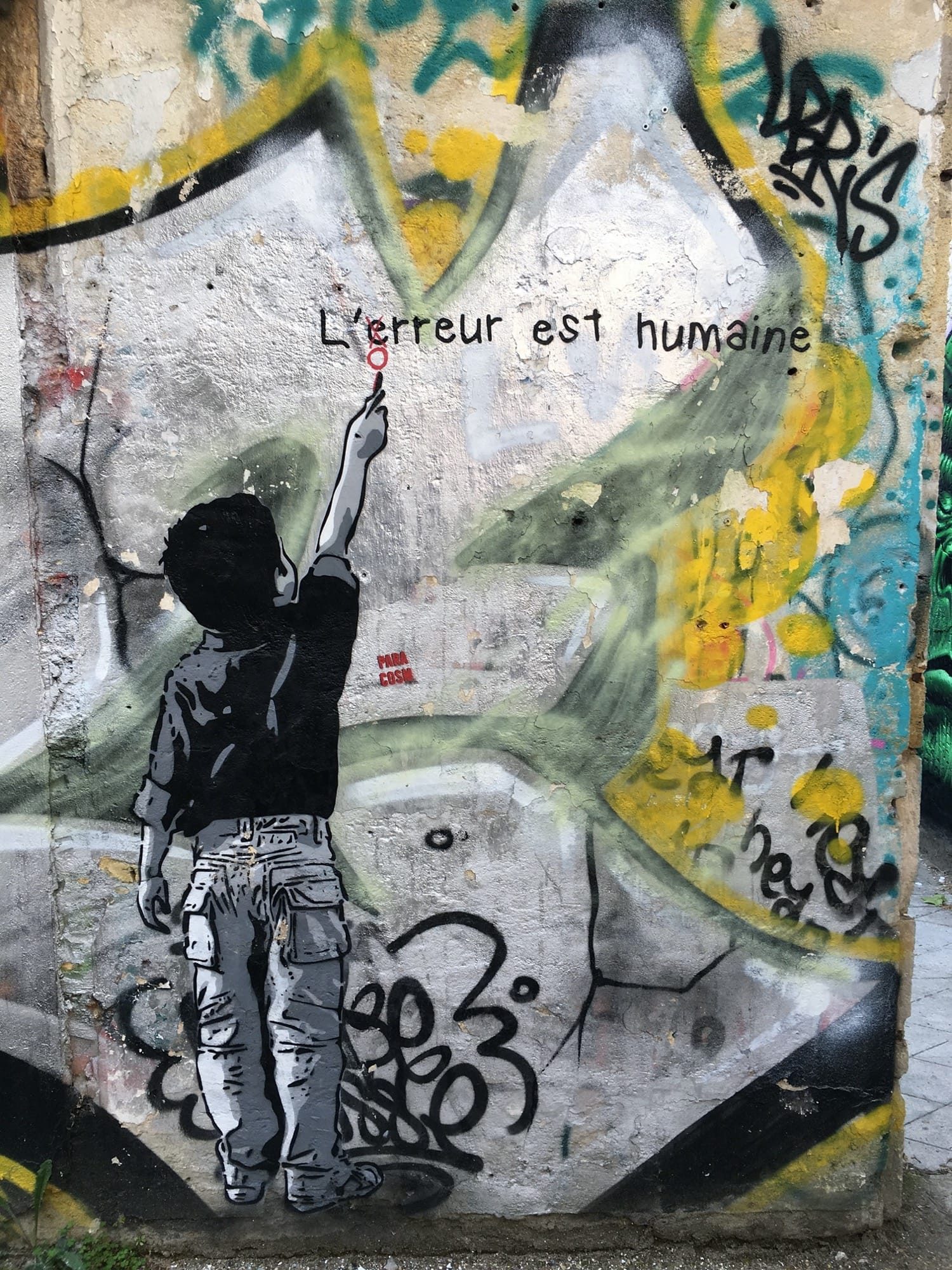
The strongest stencil on site turns on a single letter. The sentence "L'erreur est humaine" (to err is human) is painted in black, but the "e" of erreur is crossed out in red and an "o" replaces it just below, so the wall now reads "L'horreur est humaine": horror is human. The proverb that forgives our mistakes becomes a far darker statement about what people are capable of, and it is a child's silhouette, seen from behind with its finger still raised towards the correction, that delivers it. The stencil is signed Paracosm.
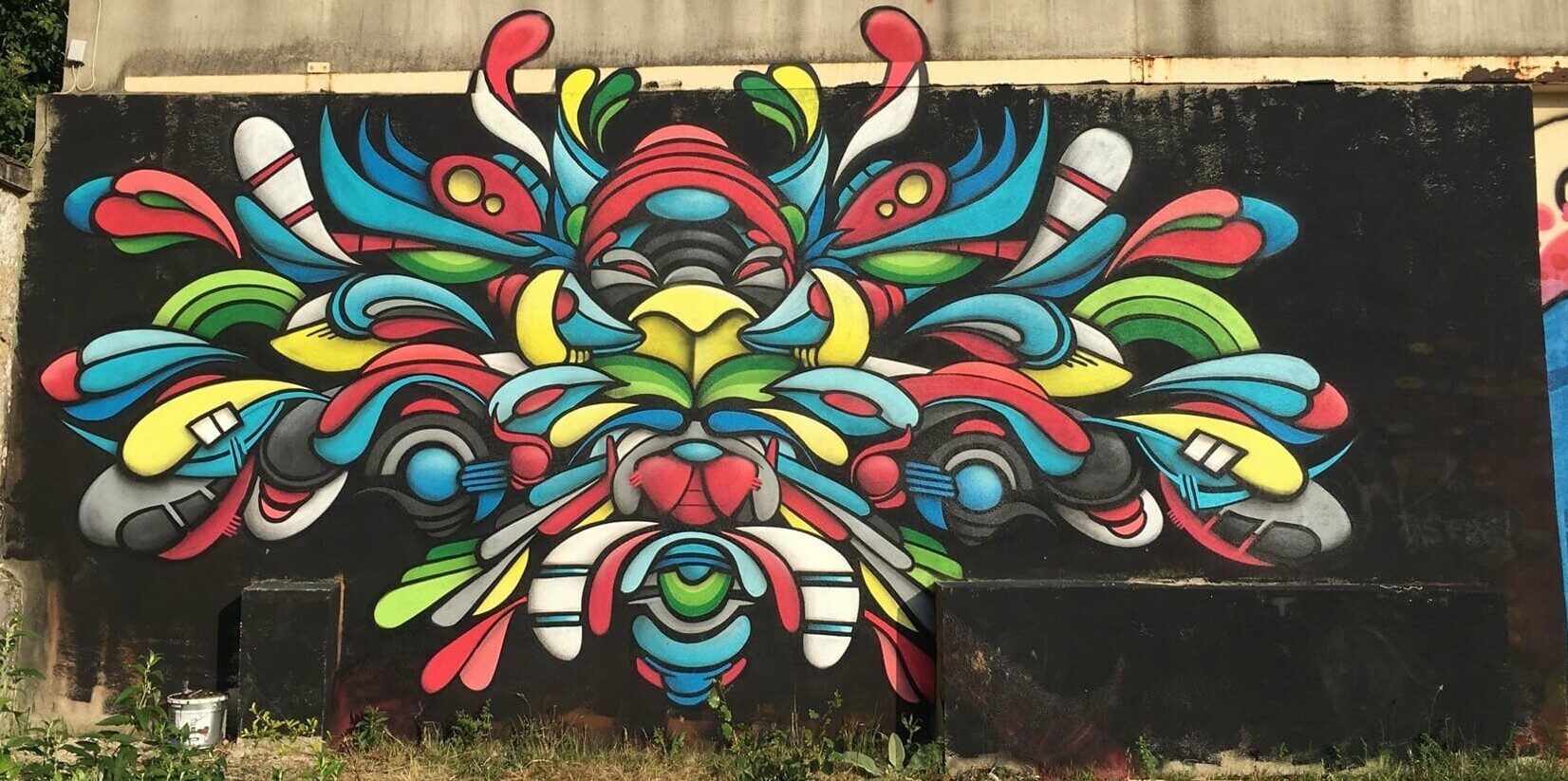
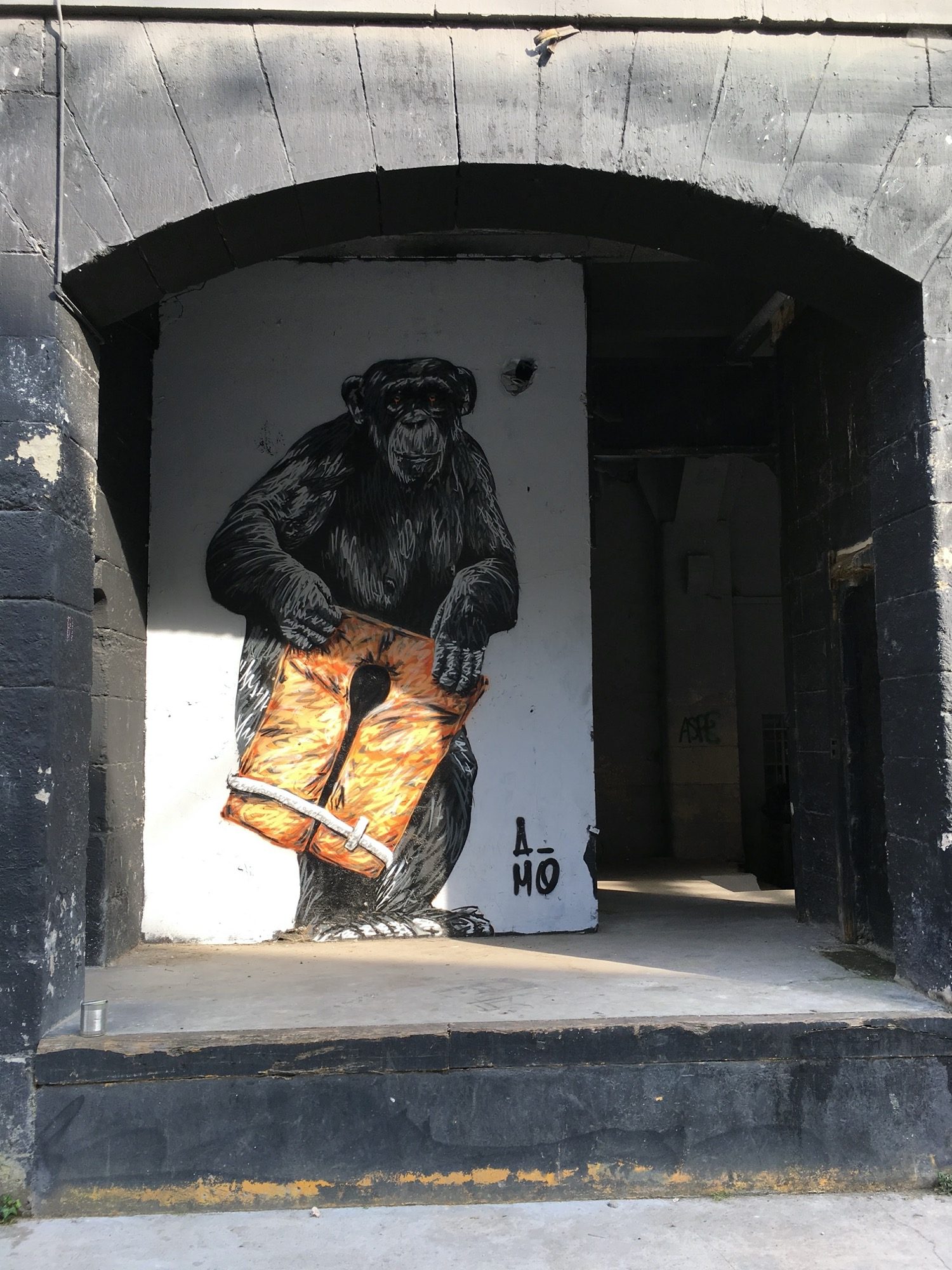
Elsewhere, on rue Hortense, the instruction "Éteint ta télé et ou..." (turn off your TV and...) is painted in red across the concrete lintel above a symmetrical totem by Raphaël, a psychedelic composition of interlocking shapes. A little further on, a muscular chimpanzee painted in black and white inside an archway swings an axe to split a log: the absurdity of the scene, a monkey chopping wood, is exactly the kind of shift this site cultivates.
Artists to look out for on site
The walls at Darwin change constantly, but a few signatures come back from one visit to the next. These are the ones we have documented on site.
- Rast: hyperrealistic celebrity portraits, including the De Niro and Al Pacino diptych on rue du Maréchal Niel.
- Alber: protest lettering and large cubist faces in saturated flat colours.
- Hopare: faces interlaced in a web of flowing lines, at the centre of the "Les Belles et la Bête" wall.
- See Ya: a two-register bestiary, from dreamlike giraffe to hyperrealistic tiger.
- Derf: photorealistic black-and-white portraits ringed with colourful tropical foliage.
- Epis: massive lettering and ecological statement, with the "Amazonia" mural.
- GZ: pointillist technique applied to animals, chameleon and owl.
- Abys and Scaf: collaborative murals with pop, unsettling imagery.
- Lélé: totems and heavily modelled gorillas in green and orange.
- MAS: black-and-white aerosol big cats, often completing a collective wall.
- Mika: abstract compositions and flowered faces in a soft palette.
- Raphaël: strictly symmetrical compositions of complex forms in a psychedelic style, on rue Hortense and on the site itself, where he signed a floral deity against a starry ground.
- Paracosm: message stencils, including the wall that turns "L'erreur est humaine" into "L'horreur est humaine".
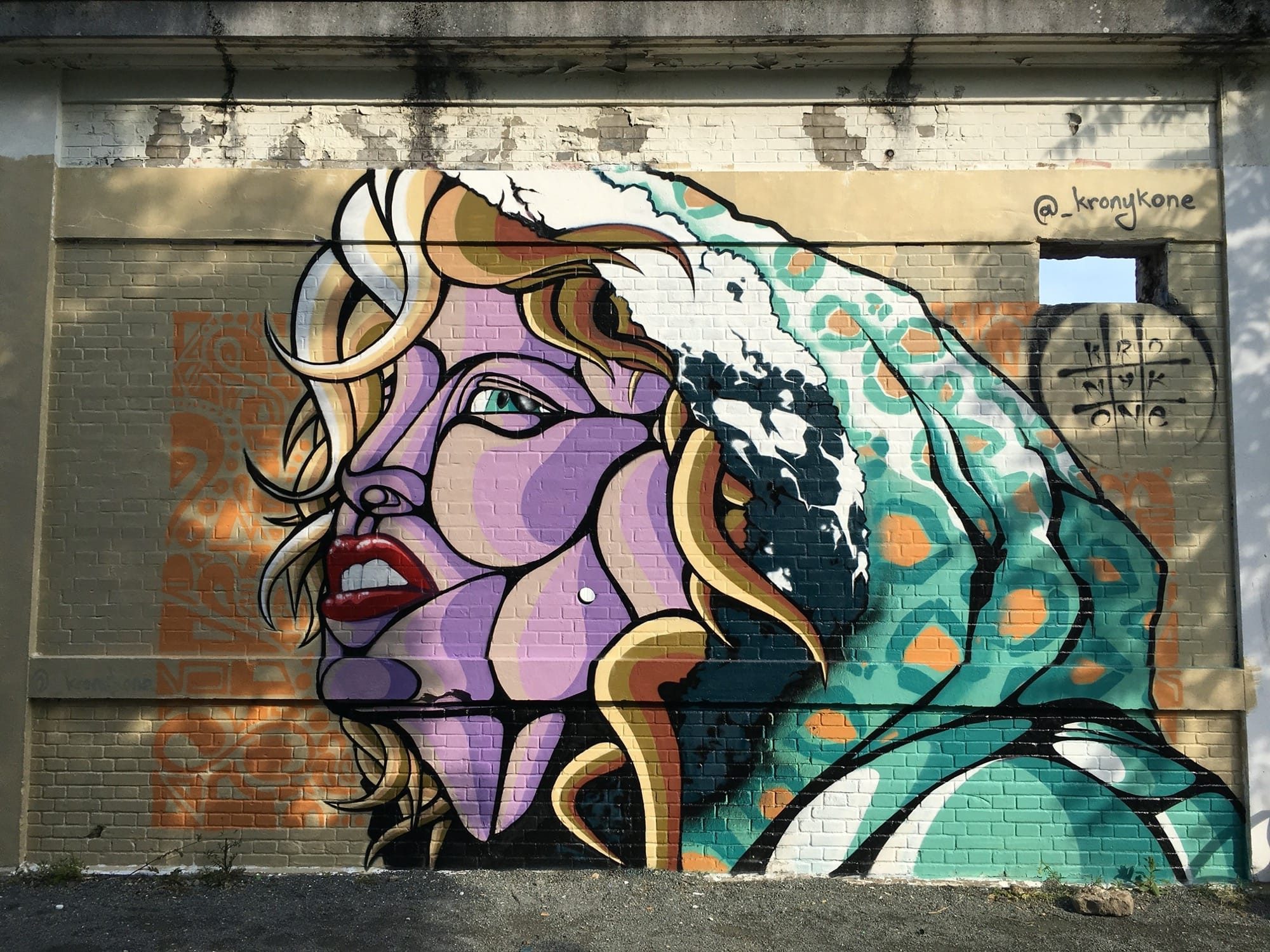
- Kronyk One: female portraits in flat purples and turquoise on brick.
Around Darwin: the Brazza quays
Street art does not stop at the barracks wall. Heading north along the quay, the Brazza wasteland and the former Nicolas shipyard extend the walk by a few hundred metres. This is Flow 76's ground, with five documented pieces here, between wildstyle and cartoon characters carrying speech bubbles.
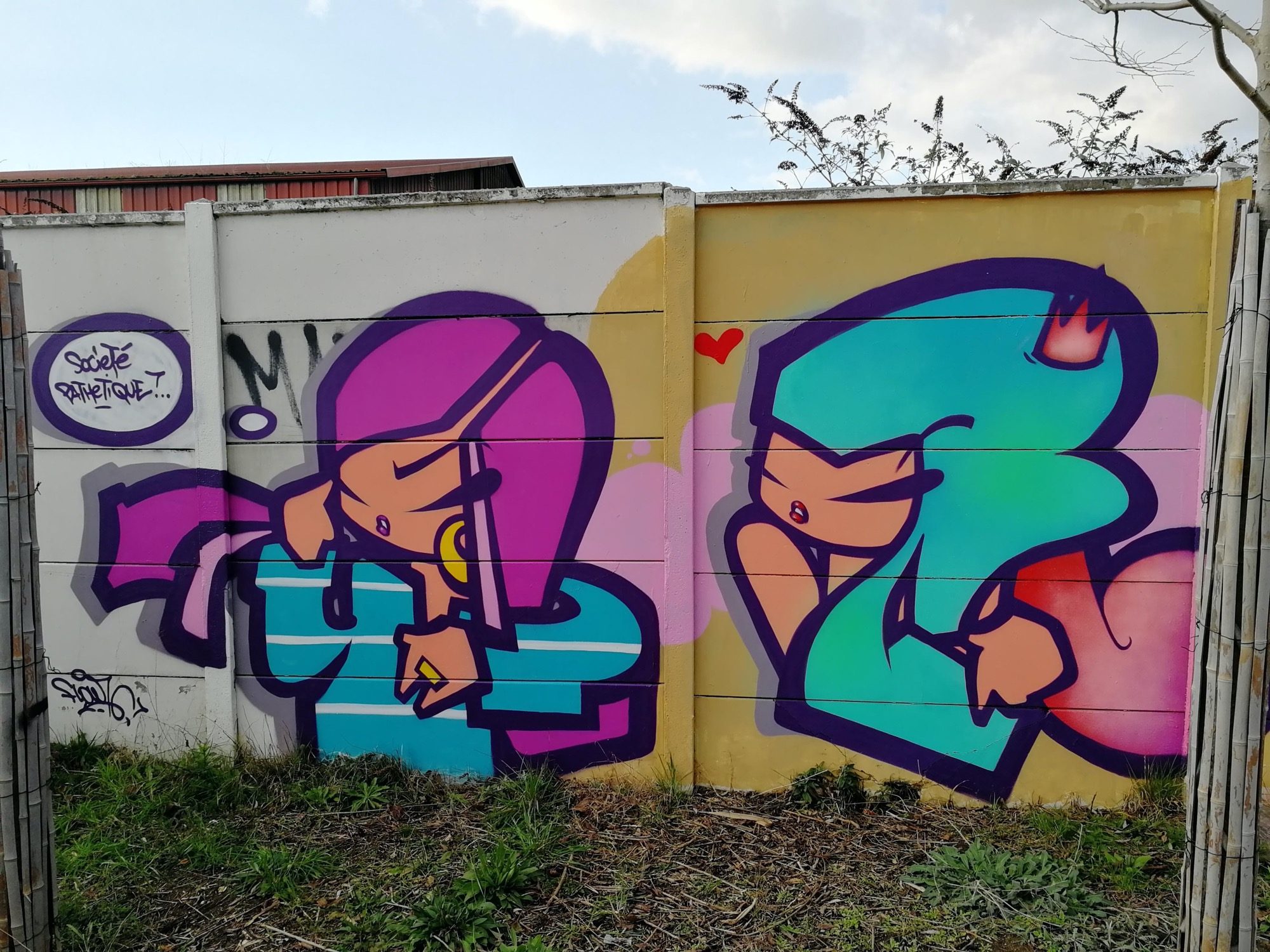
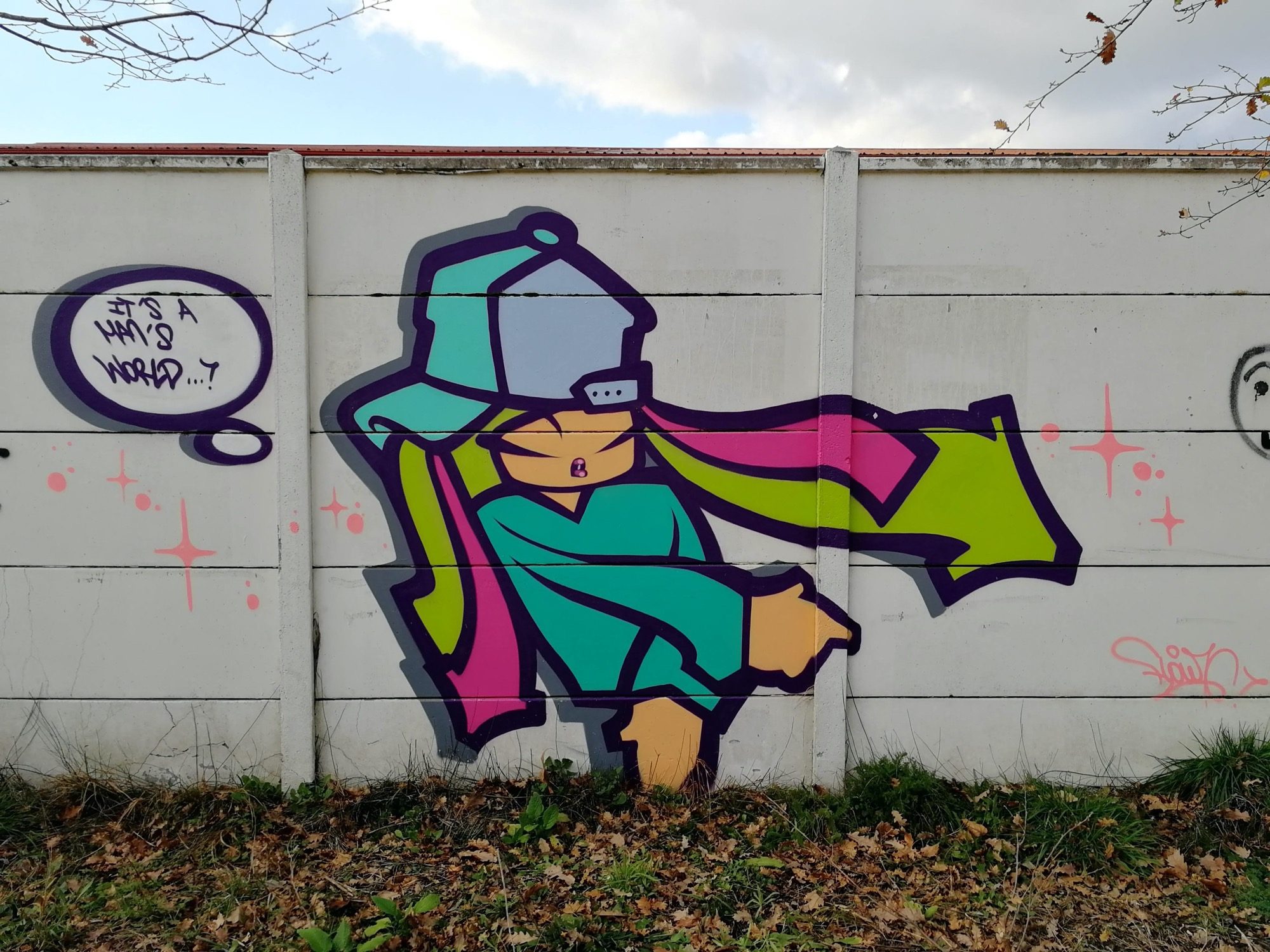
His blue-green and pink characters carry written questions, "what's a man's world?", "société pratique...?", echoing the committed tone of the neighbouring site. His orange and red wildstyles cover large surfaces with interlaced letters and carefully built depth. More broadly, Bordeaux has other street art hubs: the M.U.R. in the Chartrons, the Bassins à flot in Bacalan, the Belcier district behind Saint-Jean station, and A-mo's animals around Saint-Michel.
Climax, the festival that keeps the walls moving
Every September, Darwin hosts the Climax Festival, an event devoted to climate justice, civil liberties and solidarity, mixing concerts, debates and talks. The eleventh edition ran from 10 to 14 September 2025, and the following one is announced for 11 to 13 September. That is when the site is at its liveliest, and when some walls get repainted.
The rest of the year the place runs on its indoor skatepark, built from salvaged materials and able to hold 300 skaters, the restaurant in the Magasin Général, the organic grocery, the Emmaüs second-hand store and a bike-polo court. This constant activity explains what makes the site unusual: the murals are painted in a busy, working place rather than an abandoned lot, and they turn over all the faster for it.
How to visit Darwin
Darwin sits at 87 quai des Queyries, in the Bastide district. Tram A, Stalingrad stop, leaves you a ten-minute walk away, and a VCub bike station is right at the entrance. Access is free. Allow one to two hours to work through the northern and southern buildings without rushing, and remember to look up: several pieces are painted high, on cornices or ruined gable ends. To plan the walk, the Bordeaux map locates every work, and the full list of Bordeaux works lets you go through them one by one.
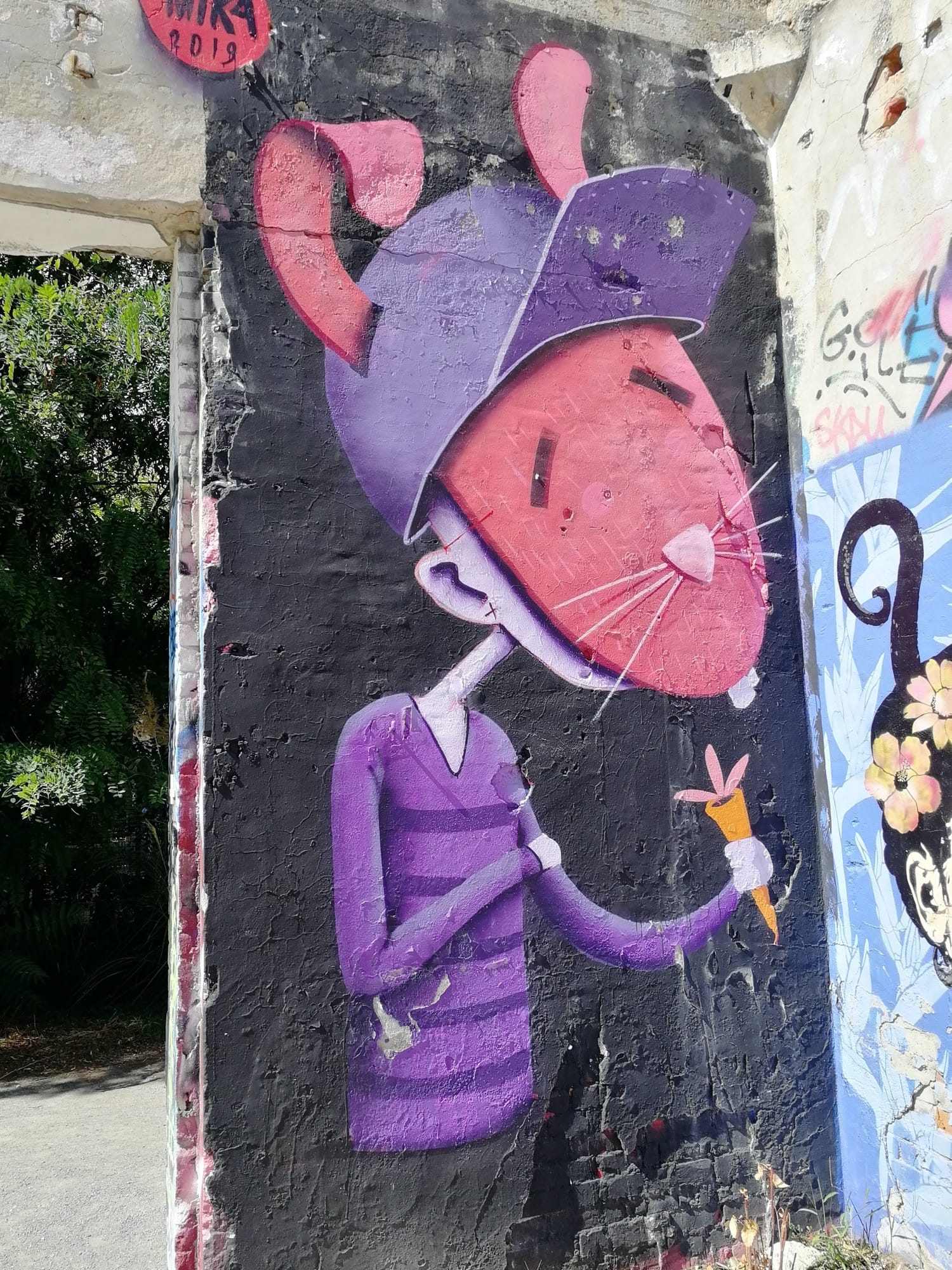
One useful caveat: nothing at Darwin is permanent. Walls get repainted, pieces get covered, and part of what you see will not be on our map yet. If you photograph a mural that is missing, you can add it in a couple of minutes so the next visitors can find it. The same pattern plays out on other converted industrial sites, such as the Fresqu'île in Nantes at the banana warehouse.
Back to blog