
Biography
ONUR
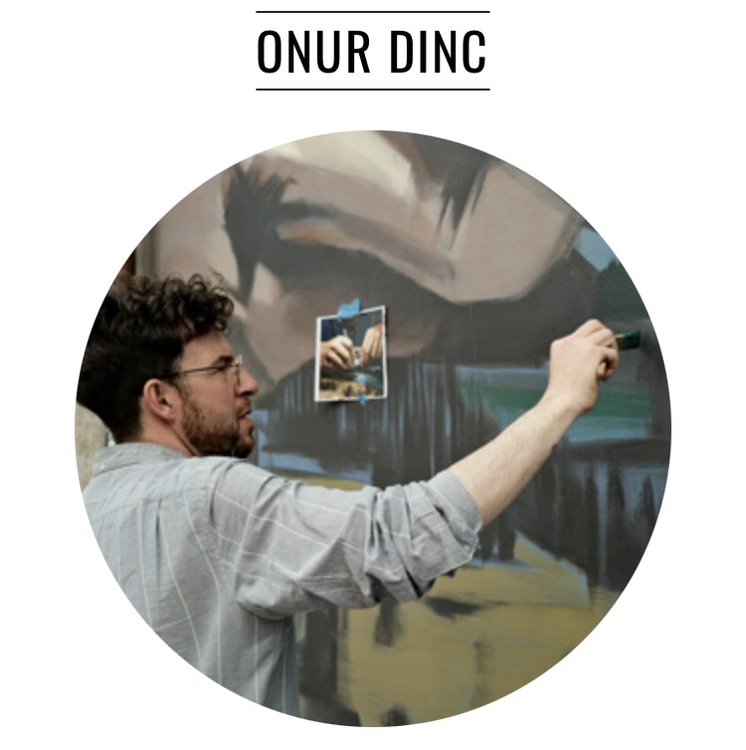
In 1979, Onur Dinc was born in Zuchwil, in the canton of Solothurn. His passion for figurative painting was initially passed on to him by his older sister, Emel. As a side note, although she possessed considerable artistic potential, Emel ultimately put away her brushes for good as an adult.
If artistic careers are sometimes considered economically risky and existentially uncertain in bourgeois families, this is even more true in modest households. Thus, when Onur decided to become a painter in his late teens, he could not rely on his parents’ encouragement. His father, shaped by his experience as a Turkish immigrant and by a life of hard work in a factory, understood little about art and viewed his son’s artistic ambitions with disapproval.
Ignoring his parents’ concerns, Onur Dinc completed an apprenticeship as a painter, then spent four years studying set design as a theatre scenic painter in Solothurn. He subsequently trained for three years as a graphic designer at the Basel advertising agency FAVO, a profession he then practised in Bern for just one year. At the age of 27, Onur began exhibiting his work in Switzerland’s and Germany’s major cities. In 2007, he worked for the final time as a theatre set painter, this time in Lucerne, before deciding the following year to devote himself exclusively to his art.
In 2008, the world of street art opened up to him. His meeting with Remo Lienhard—an exceptionally talented painter known as WES-21—and Pascal Flühmann, alias KKADE, founder of the Swiss collective “Schwarzmaler” and a member of the renowned Californian collective “The Seventh Letter,” fuelled his desire to bring his art into public spaces. A strong artistic rapport quickly developed between them, leading to numerous collaborations, particularly between Onur and WES-21. The duo made their mark by creating monumental murals in Basel, Paris, Berlin, Reykjavík, Aalborg, Budapest, Gemona del Friuli, Lagos, and major American cities such as Miami, Rochester, Richmond, and New York. The list of murals created by Onur, either collectively or independently, continues to grow.
When he is not working from a lift or on scaffolding, Onur divides his time between Solothurn, his home base, and Berlin. When he leaves his studio, it is generally to tackle large surfaces. His artistic approach is the opposite of that of the self-taught graffiti artist. As a neo-muralist influenced by photorealism, he works legally in public spaces. In this respect, his work can be described as urban art rather than street art, the latter being created “vandally,” or illegally.
Today, Onur earns a comfortable living as a painter. His work has been featured in music videos by the renowned German rapper Kool Savas. Although he is reluctant to place his art at the service of commercial enterprises, he has nevertheless worked for the car manufacturer Volvo as part of a global advertising campaign, as well as for the television channel Canal+. While his main sources of income are the sale of paintings and prints, he loves working in the street because public space encourages spontaneous exchanges with audiences more readily than galleries or museums.
His preferred tools are the brush, paintbrush, and roller. His pictorial touch, the result of gestures that are both precise and free, softens as one moves away from the work. From a distance, his paintings appear less gestural and even more realistic. It is then that one appreciates the precision with which the artist has applied each brushstroke. On occasion, Onur incorporates luminescent paint into his murals to illuminate them at night.
Considering art to be a sociological mirror, Onur believes that artists have a responsibility to comment on society and awaken people’s awareness. His interest in figuration stems from his desire to convey powerful messages through philosophically engaged and often metaphorical images. The damage inflicted by humans on nature, consumerist excesses, contemporary neuroses, everyday stupidity, and the suffering of the animal world are among the themes that inspire Onur.
As his artist name, Onur Dinc simply chose his first name, leaving out his surname. Common in Turkey and meaning “honour,” “self-respect,” and “dignity,” the name seems destined for this virtuoso, who is among Switzerland’s most prominent street artists and whose influence continues to grow. Looking back, Onur is pleased to have been able to convince his parents of the validity of his path—thus living up to his name.
The site contains a total of 1 artworks by ONUR in 1 countries.
Artworks (1)
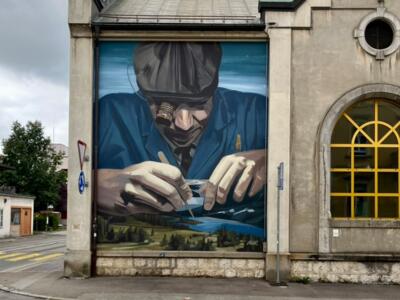
Loading…